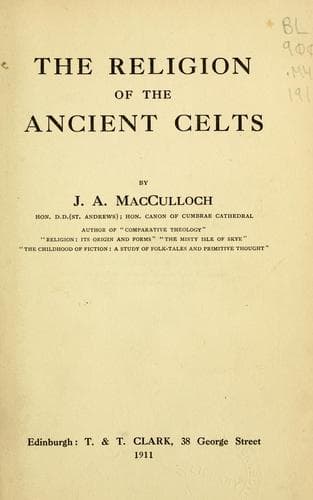
The Religion of the Ancient CeltsMacCulloch, J. A. (John Arnott)
Religion
The Religion of the Ancient Celts
MacCulloch, J. A. (John Arnott)
Celts -- Religion; Mythology, Celtic
Other stories relate the rebirth of heroes. Conchobar is variously said
to be son of Nessa by her husband Cathbad, or by her lover Fachtna. But
in the latter version an incident is found which points to a third
account. Nessa brings Cathbad a draught from a river, but in it are two
worms which he forces her to swallow. She gives birth to a son, in each
of whose hands is a worm, and he is called Conchobar, after the name of
the river into which he fell soon after his birth. The incident closes
with the words, "It was from these worms that she became pregnant, say
some."[1196] Possibly the divinity of the river had taken the form of
the worms and was reborn as Conchobar. We may compare the story of the
birth of Conall Cernach. His mother was childless, until a Druid sang
spells over a well in which she bathed, and drank of its waters. With
the draught she swallowed a worm, "and the worm was in the hand of the
boy as he lay in his mother's womb; and he pierced the hand and consumed
it."[1197]
The personality of Fionn is also connected with the rebirth idea. In one
story, Mongan, a seventh-century king, had a dispute with his poet
regarding the death of the hero Fothad. The Fian Caoilte returns from
the dead to prove Mongan right, and he says, "We were with thee, with
Fionn." Mongan bids him be silent, because he did not wish his identity
with Fionn to be made known. "Mongan, however, was Fionn, though he
would not let it be told."[1198] In another story Mongan is son of
Manannan, who had prophesied of this event. Manannan appeared to the
wife of Fiachna when he was fighting the Saxons, and told her that
unless she yielded herself to him her husband would be slain. On hearing
this she agreed, and next day the god appeared fighting with Fiachna's
forces and routed the slain. "So that this Mongan is a son of Manannan
mac Lir, though he is called Mongan son of Fiachna."[1199] In a third
version Manannan makes the bargain with Fiachna, and in his form sleeps
with the woman. Simultaneously with Mongan's birth, Fiachna's attendant
had a son who became Mongan's servant, and a warrior's wife bears a
daughter who became his wife. Manannan took Mongan to the Land of
Promise and kept him there until he was sixteen.[1200] Many magical
powers and the faculty of shape-shifting are attributed to Mongan, and
in some stories he is brought into connection with the _síd_.[1201]
Probably a myth told how he went to Elysium instead of dying, for he
comes from "the Land of Living Heart" to speak with S. Columba, who took
him to see heaven. But he would not satisfy the saints' curiosity
regarding Elysium, and suddenly vanished, probably returning
there.[1202]
This twofold account of Mongan's birth is curious. Perhaps the idea that
he was a rebirth of Fionn may have been suggested by the fact that his
father was called Fiachna Finn, while it is probable that some old myth
of a son of Manannan's called Mongan was attached to the personality of
the historic Mongan.
Public-domain text, read in full here on John Shaqi.
Reviews
Reviews
No reviews yet
Be the first to share your thoughts on this work.
Elsewhere in the archive
Join the Discussion
Join the discussion
Sign in to leave a comment or review.
Sign InorCreate an account