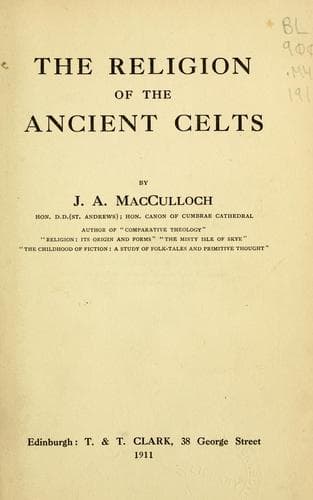
The Religion of the Ancient CeltsMacCulloch, J. A. (John Arnott)
Religion
The Religion of the Ancient Celts
MacCulloch, J. A. (John Arnott)
Celts -- Religion; Mythology, Celtic
About the era of Mongan, King Diarmaid had two wives, one of whom was
barren. S. Finnen gave her holy water to drink, and she brought forth a
lamb; then, after a second draught, a trout, and finally, after a third,
Aed Slane, who became high king of Ireland in 594. This is a
Christianised version of the story of Conall Cernach's birth.[1203]
In Welsh mythology the story of Taliesin affords an example of rebirth.
After the transformation combat of the goddess Cerridwen and Gwion,
resembling that of the swine-herds, Gwion becomes a grain of wheat,
which Cerridwen in the form of a hen swallows, with the result that he
is reborn of her as Taliesin.[1204]
Most of these stories no longer exist in their primitive form, and
various ideas are found in them--conception by magical means, divine
descent through the _amour_ of a divinity and a mortal, and rebirth.
As to the first, the help of magician or priest is often invoked in
savage society and even in European folk-custom in case of barrenness.
Prayers, charms, potions, or food are the means used to induce
conception, but perhaps at one time these were thought to cause it of
themselves. In many tales the swallowing of a seed, fruit, insect, etc.,
results in the birth of a hero or heroine, and it is probable that these
stories embody actual belief in such a possibility. If the stories of
Conall Cernach and Aed Slane are not attenuated instances of rebirth,
say, of the divinity of a well, they are examples of this belief. The
gift of fruitfulness is bestowed by Druid and saint, but in the story of
Conall it is rather the swallowing of the worm than the Druid's
incantation that causes conception, and is the real _motif_ of the tale.
Where the rebirth of a divinity occurs as the result of the swallowing
of a small animal, it is evident that the god has first taken this form.
The Celt, believing in conception by swallowing some object, and in
shape-shifting, combined his information, and so produced a third idea,
that a god could take the form of a small animal, which, when swallowed,
became his rebirth.[1205] If, as the visits of barren women to dolmens
and megalithic monuments suggest, the Celts believed in the possibility
of the spirit of a dead man entering a woman and being born of her or at
least aiding conception,--a belief held by other races,[1206]--this may
have given rise to myths regarding the rebirth of gods by human mothers.
At all events this latter Celtic belief is paralleled by the American
Indian myths, e.g. of the Thlinkeet god Yehl who transformed himself now
into a pebble, now into a blade of grass, and, being thus swallowed by
women, was reborn.
Public-domain text, read in full here on John Shaqi.
Reviews
Reviews
No reviews yet
Be the first to share your thoughts on this work.
Elsewhere in the archive
Join the Discussion
Join the discussion
Sign in to leave a comment or review.
Sign InorCreate an account