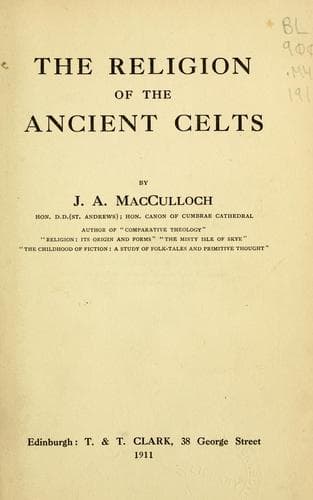
The Religion of the Ancient CeltsMacCulloch, J. A. (John Arnott)
Religion
The Religion of the Ancient Celts
MacCulloch, J. A. (John Arnott)
Celts -- Religion; Mythology, Celtic
In the stories of Etain and of Lud, reborn as Setanta, this idea of
divine transformation and rebirth occurs. A similar idea may underlie
the tale of Fionn and Mongan. As to the tales of Gwion and the
Swineherds, the latter the servants of gods, and perhaps themselves
regarded once as divinities, who in their rebirth as bulls are certainly
divine animals, they present some features which require further
consideration. The previous transformations in both cases belong to the
Transformation Combat formula of many _Märchen_, and obviously were not
part of the original form of the myths. In all such _Märchen_ the
antagonists are males, hence the rebirth incident could not form part of
them. In the Welsh tale of Gwion and in the corresponding Taliesin poem,
the ingenious fusion of the _Märchen_ formula with an existing myth of
rebirth must have taken place at an early date.[1207] This is also true
of _The Two Swineherds_, but in this case, since the myth told how two
gods took the form of worms and were reborn of cows, the formula had to
be altered. Both remain alive at the end of the combat, contrary to the
usual formula, because both were males and both were reborn. The fusion
is skilful, because the reborn personages preserve a remembrance of
their former transformations,[1208] just as Mongan knows of his former
existence as Fionn. In other cases there is no such remembrance. Etain
had forgotten her former existence, and Cúchulainn does not appear to
know that he is a rebirth of Lug.
Public-domain text, read in full here on John Shaqi.
Reviews
Reviews
No reviews yet
Be the first to share your thoughts on this work.
Elsewhere in the archive
Join the Discussion
Join the discussion
Sign in to leave a comment or review.
Sign InorCreate an account