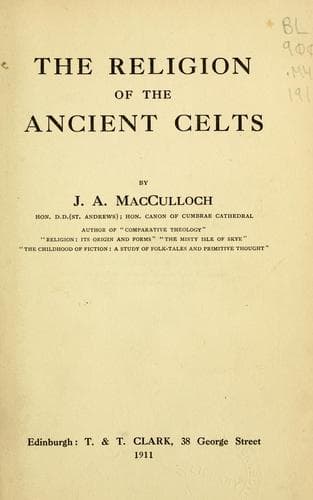
The Religion of the Ancient CeltsMacCulloch, J. A. (John Arnott)
Religion
The Religion of the Ancient Celts
MacCulloch, J. A. (John Arnott)
Celts -- Religion; Mythology, Celtic
Such Celtic stories as these may have been known to classical authors,
and have influenced their statements regarding eschatology. Yet it can
hardly be said that the tales themselves bear witness to a general
transmigration doctrine current among the Celts, since the stories
concern divine or heroic personages. Still the belief may have had a
certain currency among them, based on primitive theories of soul life.
Evidence that it existed side by side with the more general doctrines of
the future life may be found in old or existing folk-belief. In some
cases the dead have an animal form, as in the _Voyage of Maelduin_,
where birds on an island are said to be souls, or in the legend of S.
Maelsuthain, whose pupils appear to him after death as birds.[1224] The
bird form of the soul after death is still a current belief in the
Hebrides. Butterflies in Ireland, and moths in Cornwall, and in France
bats or butterflies, are believed to be souls of the dead.[1225] King
Arthur is thought by Cornishmen to have died and to have been changed
into the form of a raven, and in mediæval Wales souls of the wicked
appear as ravens, in Brittany as black dogs, petrels, or hares, or serve
their term of penitence as cows or bulls, or remain as crows till the
day of judgment.[1226] Unbaptized infants become birds; drowned sailors
appear as beasts or birds; and the souls of girls deceived by lovers
haunt them as hares.[1227]
These show that the idea of transmigration may not have been foreign to
the Celtic mind, and it may have arisen from the idea that men assumed
their totem animal's shape at death. Some tales of shape-shifting are
probably due to totemism, and it is to be noted that in Kerry peasants
will not eat hares because they contain the souls of their
grandmothers.[1228] On the other hand, some of these survivals may mean
no more than that the soul itself has already an animal form, in which
it would naturally be seen after death. In Celtic folk-belief the soul
is seen leaving the body in sleep as a bee, butterfly, gnat, mouse, or
mannikin.[1229] Such a belief is found among most savage races, and
might easily be mistaken for transmigration, or also assist the
formation of the idea of transmigration. Though the folk-survivals show
that transmigration was not necessarily alleged of all the dead, it may
have been a sufficiently vital belief to colour the mythology, as we see
from the existing tales, adulterated though these may have been.
Public-domain text, read in full here on John Shaqi.
Reviews
Reviews
No reviews yet
Be the first to share your thoughts on this work.
Elsewhere in the archive
Join the Discussion
Join the discussion
Sign in to leave a comment or review.
Sign InorCreate an account