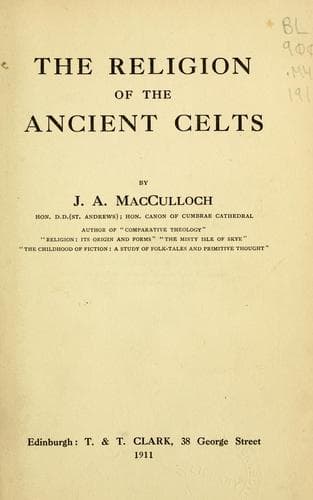
The Religion of the Ancient CeltsMacCulloch, J. A. (John Arnott)
Religion
The Religion of the Ancient Celts
MacCulloch, J. A. (John Arnott)
Celts -- Religion; Mythology, Celtic
The general belief has its roots in primitive ideas regarding life and
its propagation--ideas which some hold to be un-Celtic and un-Aryan. But
Aryans were "primitive" at some period of their history, and it would be
curious if, while still in a barbarous condition, they had forgotten
their old beliefs. In any case, if they adopted similar beliefs from
non-Aryan people, this points to no great superiority on their part.
Such beliefs originated the idea of rebirth and transmigration.[1230]
Nevertheless this was not a characteristically Celtic eschatological
belief; that we find in the theory that the dead lived on in the body or
assumed a body in another region, probably underground.
FOOTNOTES:
[1193] For textual details see Zimmer, _Zeit. für Vergl. Sprach._
xxviii. 585 f. The tale is obviously archaic. For a translation see
Leahy, i. 8 f.
[1194] _IT_ i. 134 f.; D'Arbois, v. 22. There is a suggestion in one of
the versions of another story, in which Setanta is child of Conchobar
and his sister Dechtire.
[1195] _IT_ iii. 245; _RC_ xv. 465; Nutt-Meyer, ii. 69.
[1196] Stowe MS. 992, _RC_ vi. 174; _IT_ ii. 210; D'Arbois, v. 3f.
[1197] _IT_ iii. 393. Cf. the story of the wife of Cormac, who was
barren till her mother gave her pottage. Then she had a daughter (_RC_
xxii. 18).
[1198] Nutt-Meyer, i. 45 f., text and translation.
[1199] Ibid. 42 f.
[1200] Ibid. 58. The simultaneous birth formula occurs in many
_Märchen_, though that of the future wife is not common.
[1201] Nutt-Meyer, i. 52, 57, 85, 87.
[1202] _ZCP_ ii. 316 f. Here Mongan comes directly from Elysium, as does
Oisin before meeting S. Patrick.
[1203] _IT_ iii. 345; O'Grady, ii. 88. Cf. Rees, 331.
[1204] Guest, iii. 356 f.; see p. 116, _supra_.
[1205] In some of the tales the small animal still exists independently
after the birth, but this is probably not their primitive form.
[1206] See my _Religion: Its Origin and Forms_, 76-77.
[1207] Skene, i. 532. After relating various shapes in which he has
been, the poet adds that he has been a grain which a hen received, and
that he rested in her womb as a child. The reference in this early poem
from a fourteenth century MS. shows that the fusion of the _Märchen_
formula with a myth of rebirth was already well known. See also Guest,
iii. 362, for verses in which the transformations during the combat are
exaggerated.
[1208] Skene, i. 276, 532.
[1209] Miss Hull, 67; D'Arbois, v. 331.
[1210] For various forms of _geno_-, see Holder, i. 2002; Stokes, _US_
110.
[1211] For all these names see Holder, _s.v._
Public-domain text, read in full here on John Shaqi.
Reviews
Reviews
No reviews yet
Be the first to share your thoughts on this work.
Elsewhere in the archive
Join the Discussion
Join the discussion
Sign in to leave a comment or review.
Sign InorCreate an account