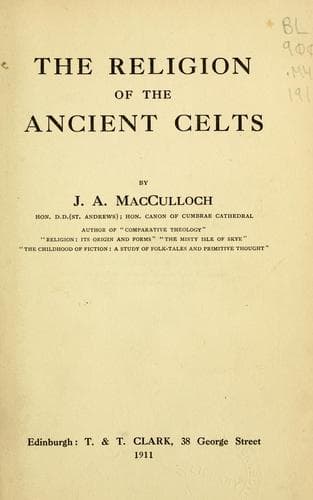
The Religion of the Ancient CeltsMacCulloch, J. A. (John Arnott)
Religion
The Religion of the Ancient Celts
MacCulloch, J. A. (John Arnott)
Celts -- Religion; Mythology, Celtic
4. _Co-extensive with this world._--An early example of this type is
found in the _Adventures of Cormac_. A divine visitant appeared to
Cormac and gave him in exchange for his wife, son, and daughter, his
branch of golden apples, which when shaken produced sweetest music,
dispelling sorrow. After a year Cormac set out to seek his family, and
as he journeyed encountered a mist in which he discovered a strange
house. Its master and mistress--Manannan and his consort--offered him
shelter. The god brought in a pig, every quarter of which was cooked in
the telling of a true tale, the pig afterwards coming to life again.
Cormac, in his tale, described how he had lost his family, whereupon
Manannan made him sleep, and brought his wife and children in. Later he
produced a cup which broke when a lie was told, but became whole again
when a true word was spoken. The god said Cormac's wife had now a new
husband, and the cup broke, but was restored when the goddess declared
this to be a lie. Next morning all had disappeared, and Cormac and his
family found themselves in his own palace, with cup and branch by their
side.[1242] Similarly, in _The Champion's Ecstasy_, a mysterious
horseman appears out of a mist to Conn and leads him to a palace, where
he reveals himself as the god Lug, and where there is a woman called
"the Sovereignty of Erin." Beside the palace is a golden tree.[1243] In
the story of Bran, Mag Mell is said to be all around the hero, though he
knows it not--an analogous conception to what is found in these tales,
and another instance is that of the mysterious house entered by
Conchobar and Dechtire.[1244] Mag Mell may thus have been regarded as a
mysterious district of Erin. This magic mist enclosing a marvellous
dwelling occurs in many other tales, and it was in a mist that the
Tuatha Déa came to Ireland.
A certain correspondence to these Irish beliefs is found in Brythonic
story, but here the Elysium conception has been influenced by Christian
ideas. Elysium is called _Annwfn_, meaning "an abyss," "the state of the
dead," "hell," and it is also conceived of as _is elfydd_, "beneath the
earth."[1245] But in the tales it bears no likeness to these meanings of
the word, save in so far as it has been confused by their Christian
redactors with hell. It is a region on the earth's surface or an over-or
under-sea world, in which some of the characteristics of the Irish
Elysium are found--a cauldron, a well of drink sweeter than wine, and
animals greatly desired by mortals, while it is of great beauty and its
people are not subject to death or disease. Hence the name _Annwfn_ has
probably taken the place of some earlier pagan title of Elysium.
Public-domain text, read in full here on John Shaqi.
Reviews
Reviews
No reviews yet
Be the first to share your thoughts on this work.
Elsewhere in the archive
Join the Discussion
Join the discussion
Sign in to leave a comment or review.
Sign InorCreate an account