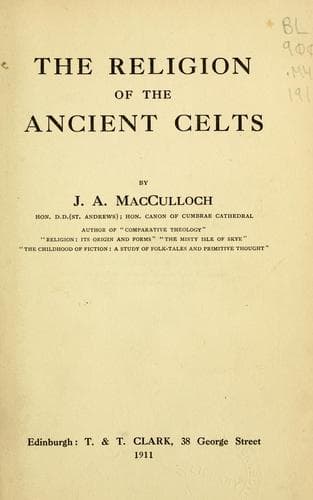
The Religion of the Ancient CeltsMacCulloch, J. A. (John Arnott)
Religion
The Religion of the Ancient Celts
MacCulloch, J. A. (John Arnott)
Celts -- Religion; Mythology, Celtic
In the tale of Pwyll, the earliest reference to _Annwfn_ occurs. It is
ruled by Arawn, at war with Hafgan. Arawn obtains the help of Pwyll by
exchanging kingdoms with him for a year, and Pwyll defeats Hafgan. It is
a beautiful land, where merriment and feasting go on continuously, and
its queen is of great loveliness. It has no subterranean character, and
is conceived apparently as contiguous to Pwyll's kingdom.[1246] In other
tales it is the land whence Gwydion and others obtain various
animals.[1247] The later folk-conception of the demoniac dogs of Annwfn
may be based on an old myth of dogs with which its king hunted. These
are referred to in the story of Pwyll.[1248]
_Annwfn_ is also the name of a land under waves or over sea, called also
_Caer Sidi_, "the revolving castle," about which "are ocean's streams."
It is "known to Manawyddan and Pryderi," just as the Irish Elysium was
ruled by Manannan.[1249] Another "Caer of Defence" is beneath the
waves.[1250] Perhaps the two ideas were interchangeable. The people of
this land are free from death and disease, and in it is "an abundant
well, sweeter than white wine the drink in it." There also is a cauldron
belonging to the lord of Annwfn, which was stolen by Arthur and his men.
Such a cauldron is the property of people belonging to a water world in
the _Mabinogion_.[1251]
The description of the isle of Avallon (later identified with
Glastonbury), whither Arthur was carried, completes the likeness to the
Irish Elysium. No tempest, excess of heat or cold, nor noxious animal
afflicts it; it is blessed with eternal spring and with fruit and
flowers growing without labour; it is the land of eternal youth,
unvisited by death or disease. It has a _regia virgo_ lovelier than her
lovely attendants; she cured Arthur of his wounds, hence she is the
Morgen of other tales, and she and her maidens may be identified with
the divine women of the Irish isle of women. Morgen is called a _dea
phantastica_, and she may be compared with Liban, who cured Cúchulainn
of his sickness.[1252]
Public-domain text, read in full here on John Shaqi.
Reviews
Reviews
No reviews yet
Be the first to share your thoughts on this work.
Elsewhere in the archive
Join the Discussion
Join the discussion
Sign in to leave a comment or review.
Sign InorCreate an account