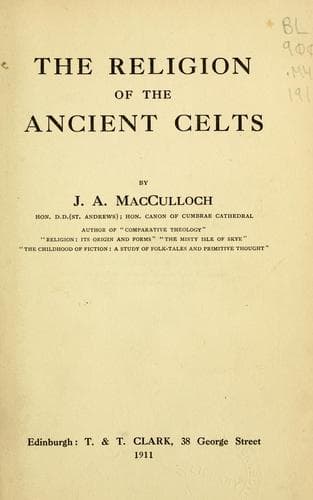
The Religion of the Ancient CeltsMacCulloch, J. A. (John Arnott)
Religion
The Religion of the Ancient Celts
MacCulloch, J. A. (John Arnott)
Celts -- Religion; Mythology, Celtic
A goddess of the chase was identified with Artemis in Galatia, where she
had a priestess Camma, and also in the west. At the feast of the
Galatian goddess dogs were crowned with flowers, her worshippers feasted
and a sacrifice was made to her, feast and sacrifice being provided out
of money laid aside for every animal taken in the chase.[126] Other
goddesses were equated with Diana, and one of her statues was destroyed
in Christian times at Trèves.[127] These goddesses may have been thought
of as rushing through the forest with an attendant train, since in later
times Diana, with whom they were completely assimilated, became, like
Holda, the leader of the "furious host" and also of witches'
revels.[128] The Life of Cæsarius of Arles speaks of a "demon" called
Diana by the rustics. A bronze statuette represents the goddess riding a
wild boar,[129] her symbol and, like herself, a creature of the forest,
but at an earlier time itself a divinity of whom the goddess became the
anthropomorphic form.
Goddesses, the earlier spirits of the waters, protected rivers and
springs, or were associated with gods of healing wells. Dirona or Sirona
is associated with Grannos mainly in Eastern Gaul and the Rhine
provinces, and is sometimes represented carrying grapes and grain.[130]
Thus this goddess may once have been connected with fertility, perhaps
an Earth-mother, and if her name means "the long-lived,"[131] this would
be an appropriate title for an Earth-goddess. Another goddess, Stanna,
mentioned in an inscription at Perigueux, is perhaps "the standing or
abiding one," and thus may also have been Earth-goddess.[132] Grannos
was also associated with the local goddesses Vesunna and Aventia, who
gave their names to Vesona and Avanche. His statue also stood in the
temple of the goddess of the Seine, Sequana.[133] With Bormo were
associated Bormana in Southern Gaul, and Damona in Eastern Gaul--perhaps
an animal goddess, since the root of her name occurs in Irish _dam_,
"ox," and Welsh _dafad_, "sheep." Dea Brixia was the consort of
Luxovius, god of the waters of Luxeuil. Names of other goddesses of the
waters are found on _ex votos_ and plaques which were placed in or near
them. The Roman Nymphæ, sometimes associated with Bormo, were the
equivalents of the Celtic water-goddesses, who survived in the
water-fairies of later folk-belief. Some river-goddesses gave their
names to many rivers in the Celtic area--the numerous Avons being named
from Abnoba, goddess of the sources of the Danube, and the many Dees and
Dives from Divona. Clota was goddess of the Clyde, Sabrina had her
throne "beneath the translucent wave" of the Severn, Icauna was goddess
of the Yonne, Sequana of the Seine, and Sinnan of the Shannon.
Public-domain text, read in full here on John Shaqi.
Reviews
Reviews
No reviews yet
Be the first to share your thoughts on this work.
Join the Discussion
Join the discussion
Sign in to leave a comment or review.
Sign InorCreate an account