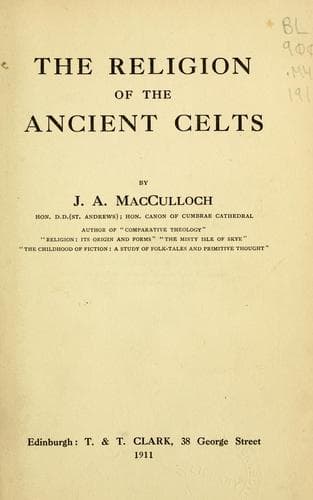
The Religion of the Ancient CeltsMacCulloch, J. A. (John Arnott)
Religion
The Religion of the Ancient Celts
MacCulloch, J. A. (John Arnott)
Celts -- Religion; Mythology, Celtic
[135] Holder, _s.v._; see p. 213, _infra_.
[136] Holder, ii. 463. They are very numerous in South-East Gaul, where
also three-headed gods are found.
[137] See pp. 274-5, _infra_.
[138] Courcelle-Seneuil, 80-81.
[139] See my article "Calendar" in Hastings' _Encyclop. of Religion and
Ethics_, iii. 80.
[140] _CIL_ v. 4208, 5771, vii. 927; Holder, ii. 89.
[141] For all these titles see Holder, _s.v._
[142] There is a large literature devoted to the _Matres_. See De Wal,
_Die Mæder Gottinem_; Vallentin, _Le Culte des Matræ_; Daremberg-Saglio,
_Dict. s.v. Matres_; Ihm, _Jahrbuch. des Vereins von Alterth. in
Rheinlande_, No. 83; Roscher, _Lexicon_, ii. 2464 f.
[143] See Maury, _Fées du Moyen Age_; Sébillot, i. 262; Monnier, 439 f.;
Wright, _Celt, Roman, and Saxon_, 286 f.; Vallentin, _RC_ iv. 29. The
_Matres_ may already have had a sinister aspect in Roman times, as they
appear to be intended by an inscription _Lamiis Tribus_ on an altar at
Newcastle. Hübner, 507.
[144] Anwyl, _Celt. Rev._ 1906, 28. Cf. _Y Foel Famau_, "the hill of the
Mothers," in the Clwydian range.
[145] See p. 73, _infra_.
[146] Vallentin, _op. cit._ iv. 29; Maury, _Croyances du Moyen Age_,
382.
[147] Holder, _s.v._
[148] See pp. 69, 317, _infra_.
[149] For all these see Holder, _s.v._; Rh[^y]s, _HL_ 103; _RC_ iv. 34.
[150] Florus, ii. 4.
[151] See the table of identifications, p. 125, _infra_.
[152] We need not assume with Jullian, 18, that there was one supreme
god, now a war-god, now a god of peace. Any prominent god may have
become a war-god on occasion.
CHAPTER IV.
THE IRISH MYTHOLOGICAL CYCLE.
Three divine and heroic cycles of myths are known in Ireland, one
telling of the Tuatha Dé Danann, the others of Cúchulainn and of the
Fians. They are distinct in character and contents, but the gods of the
first cycle often help the heroes of the other groups, as the gods of
Greece and India assisted the heroes of the epics. We shall see that
some of the personages of these cycles may have been known in Gaul; they
are remembered in Wales, but, in the Highlands, where stories of
Cúchulainn and Fionn are still told, the Tuatha Dé Danann are less known
now than in 1567, when Bishop Carsewell lamented the love of the
Highlanders for "idle, turbulent, lying, worldly stories concerning the
Tuatha Dédanans."[153]
Public-domain text, read in full here on John Shaqi.
Reviews
Reviews
No reviews yet
Be the first to share your thoughts on this work.
Join the Discussion
Join the discussion
Sign in to leave a comment or review.
Sign InorCreate an account