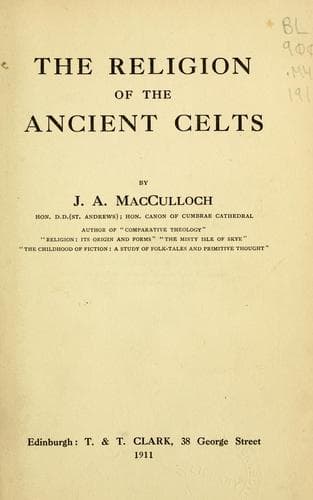
The Religion of the Ancient CeltsMacCulloch, J. A. (John Arnott)
Religion
The Religion of the Ancient Celts
MacCulloch, J. A. (John Arnott)
Celts -- Religion; Mythology, Celtic
vessel of their fleet are descended the Irish. Another version makes the
Nemedians the assailants. Thirty of them survived their defeat, some of
them going to Scotland or Man (the Britons), some to Greece (to return
as the Firbolgs), some to the north, where they learned magic and
returned as the Tuatha Dé Danann.[163] The Firbolgs, "men of bags,"
resenting their ignominious treatment by the Greeks, escaped to Ireland.
They included the Firbolgs proper, the Fir-Domnann, and the
Galioin.[164] The Fomorians are called their gods, and this, with the
contemptuous epithets bestowed on them, may point to the fact that the
Firbolgs were the pre-Celtic folk of Ireland and the Fomorians their
divinities, hostile to the gods of the Celts or regarded as dark
deities. The Firbolgs are vassals of Ailill and Medb, and with the Fir
Domnann and Galioin are hostile to Cúchulainn and his men,[165] just as
Fomorians were to the Tuatha Dé Danann. The strifes of races and of
their gods are inextricably confused.
The Tuatha Dé Danann arrived from heaven--an idea in keeping with their
character as beneficent gods, but later legend told how they came from
the north. They reached Ireland on Beltane, shrouded in a magic mist,
and finally, after one or, in other accounts, two battles, defeated the
Firbolgs and Fomorians at Magtured. The older story of one battle may be
regarded as a euhemerised account of the seeming conflict of nature
powers.[166] The first battle is described in a fifteenth to sixteenth
century MS.,[167] and is referred to in a fifteenth century account of
the second battle, full of archaic reminiscences, and composed from
various earlier documents.[168] The Firbolgs, defeated in the first
battle, join the Fomorians, after great losses. Meanwhile Nuada, leader
of the Tuatha Dé Danann, lost his hand, and as no king with a blemish
could sit on the throne, the crown was given to Bres, son of the
Fomorian Elatha and his sister Eri, a woman of the Tuatha Dé Danann. One
day Eri espied a silver boat speeding to her across the sea. From it
stepped forth a magnificent hero, and without delay the pair, like the
lovers in Theocritus, "rejoiced in their wedlock." The hero, Elatha,
foretold the birth of Eri's son, so beautiful that he would be a
standard by which to try all beautiful things. He gave her his ring, but
she was to part with it only to one whose finger it should fit. This was
her child Bres, and by this token he was later, as an exile, recognised
by his father, and obtained his help against the Tuatha Dé Danann. Like
other wonderful children, Bres grew twice as quickly as any other child
until he was seven.[169] Though Elatha and Eri are brother and sister,
she is among the Tuatha Dé Danann.[170] There is the usual inconsistency
of myth here and in other accounts of Fomorian and Tuatha Dé Danann
unions. The latter had just landed, but already had united in marriage
with the Fomorians. This inconsistency escaped the chroniclers, but it
Public-domain text, read in full here on John Shaqi.
Reviews
Reviews
No reviews yet
Be the first to share your thoughts on this work.
Join the Discussion
Join the discussion
Sign in to leave a comment or review.
Sign InorCreate an account