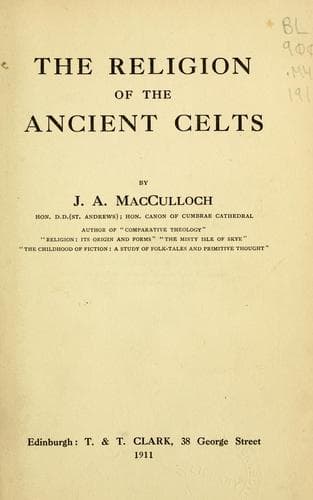
The Religion of the Ancient CeltsMacCulloch, J. A. (John Arnott)
Religion
The Religion of the Ancient Celts
MacCulloch, J. A. (John Arnott)
Celts -- Religion; Mythology, Celtic
"Ye are gods, and, behold, ye shall die, and the waves be upon you at
last.
In the darkness of time, in the deeps of the years, in the changes of
things,
Ye shall sleep as a slain man sleeps, and the world shall forget you for
kings."
From the annalistic point of view the Fomorians are sea demons or
pirates, their name being derived from _muir_, "sea," while they are
descended along with other monstrous beings from them. Professor
Rh[^y]s, while connecting the name with Welsh _foawr_, "giant" (Gaelic
_famhair_), derives the name from _fo_, "under," and _muir_, and regards
them as submarine beings.[175] Dr. MacBain connected them with the
fierce powers of the western sea personified, like the _Muireartach_, a
kind of sea hag, of a Fionn ballad.[176] But this association of the
Fomorians with the ocean may be the result of a late folk-etymology,
which wrongly derived their name from _muir_. The Celtic experience of
the Lochlanners or Norsemen, with whom the Fomorians are
associated,[177] would aid the conception of them as sea-pirates of a
more or less demoniacal character. Dr. Stokes connects the second
syllable _mor_ with _mare_ in "nightmare," from _moro_, and regards them
as subterranean as well as submarine.[178] But the more probable
derivation is that of Zimmer and D'Arbois, from _fo_ and _morio_ (_mor_,
"great"),[179] which would thus agree with the tradition which regarded
them as giants. They were probably beneficent gods of the aborigines,
whom the Celtic conquerors regarded as generally evil, perhaps equating
them with the dark powers already known to them. They were still
remembered as gods, and are called "champions of the _síd_," like the
Tuatha Dé Danann.[180] Thus King Bres sought to save his life by
promising that the kine of Ireland would always be in milk, then that
the men of Ireland would reap every quarter, and finally by revealing
the lucky days for ploughing, sowing, and reaping.[181] Only an
autochthonous god could know this, and the story is suggestive of the
true nature of the Fomorians. The hostile character attributed to them
is seen from the fact that they destroyed corn, milk, and fruit. But in
Ireland, as elsewhere, this destructive power was deprecated by begging
them not to destroy "corn nor milk in Erin beyond their fair
tribute."[182] Tribute was also paid to them on Samhain, the time when
the powers of blight feared by men are in the ascendant. Again, the
kingdom of Balor, their chief, is still described as the kingdom of
cold.[183] But when we remember that a similar "tribute" was paid to
Cromm Cruaich, a god of fertility, and that after the conquest of the
Tuatha Dé Danann they also were regarded as hostile to agriculture,[184]
we realise that the Fomorians must have been aboriginal gods of
fertility whom the conquering Celts regarded as hostile to them and
their gods. Similarly, in folk-belief the beneficent corn-spirit has
Public-domain text, read in full here on John Shaqi.
Reviews
Reviews
No reviews yet
Be the first to share your thoughts on this work.
Join the Discussion
Join the discussion
Sign in to leave a comment or review.
Sign InorCreate an account