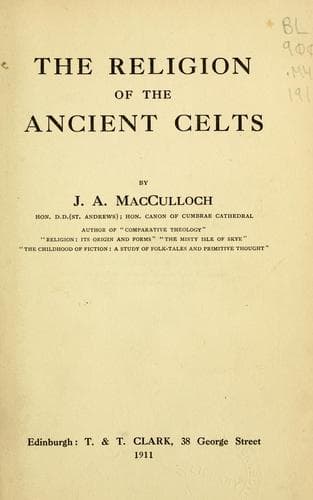
The Religion of the Ancient CeltsMacCulloch, J. A. (John Arnott)
Religion
The Religion of the Ancient Celts
MacCulloch, J. A. (John Arnott)
Celts -- Religion; Mythology, Celtic
Manannan appears in the Cúchulainn and Fionn cycles, usually as a ruler
of the Other-world. His wife Fand was Cúchulainn's mistress, Diarmaid
was his pupil in fairyland, and Cormac was his guest there. Even in
Christian times surviving pagan beliefs caused legend to be busy with
his name. King Fiachna was fighting the Scots and in great danger, when
a stranger appeared to his wife and announced that he would save her
husband's life if she would consent to abandon herself to him. She
reluctantly agreed, and the child of the _amour_ was the seventh-century
King Mongan, of whom the annalist says, "every one knows that his real
father was Manannan."[308] Mongan was also believed to be a rebirth of
Fionn. Manannan is still remembered in folk-tradition, and in the Isle
of Man, where his grave is to be seen, some of his ritual survived until
lately, bundles of rushes being placed for him on midsummer eve on two
hills.[309] Barintus, who steers Arthur to the fortunate isles, and S.
Barri, who crossed the sea on horseback, may have been legendary forms
of a local sea-god akin to Manannan, or of Manannan himself.[310] His
steed was Enbarr, "water foam _or_ hair," and Manannan was "the horseman
of the manéd sea." "Barintus," perhaps connected with _barr find_,
"white-topped," would thus be a surname of the god who rode on Enbarr,
the foaming wave, or who was himself the wave, while his mythic
sea-riding was transferred to the legend of S. Barri, if such a person
ever existed.
Various magical possessions were ascribed to Manannan--his armour and
sword, the one making the wearer invulnerable, the other terrifying all
who beheld it; his horse and canoe; his swine, which came to life again
when killed; his magic cloak; his cup which broke when a lie was spoken;
his tablecloth, which, when waved, produced food. Many of these are
found everywhere in _Märchen_, and there is nothing peculiarly Celtic in
them. We need not, therefore, with the mythologists, see in his armour
the vapoury clouds or in his sword lightning or the sun's rays. But
their magical nature as well as the fact that so much wizardry is
attributed to Manannan, points to a copious mythology clustering round
the god, now for ever lost.
Public-domain text, read in full here on John Shaqi.
Reviews
Reviews
No reviews yet
Be the first to share your thoughts on this work.
Elsewhere in the archive
Join the Discussion
Join the discussion
Sign in to leave a comment or review.
Sign InorCreate an account