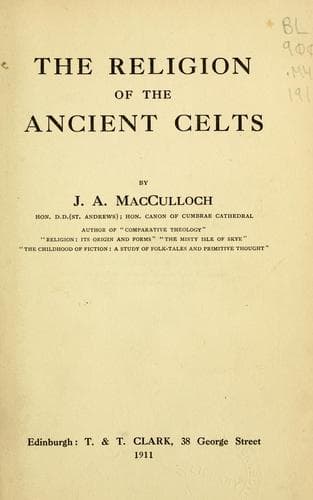
The Religion of the Ancient CeltsMacCulloch, J. A. (John Arnott)
Religion
The Religion of the Ancient Celts
MacCulloch, J. A. (John Arnott)
Celts -- Religion; Mythology, Celtic
The parentage of Lug is differently stated, but that account which makes
him son of Cian and of Ethne, daughter of Balor, is best attested.[311]
Folk-tradition still recalls the relation of Lug and Balor. Balor, a
robber living in Tory Island, had a daughter whose son was to kill her
father. He therefore shut her up in an inaccessible place, but in
revenge for Balor's stealing MacIneely's cow, the latter gained access
to her, with the result that Ethne bore three sons, whom Balor cast into
the sea. One of them, Lug, was recovered by MacIneely and fostered by
his brother Gavida. Balor now slew MacIneely, but was himself slain by
Lug, who pierced his single eye with a red-hot iron.[312] In another
version, Kian takes MacIneely's place and is aided by Manannan, in
accordance with older legends.[313] But Lug's birth-story has been
influenced in these tales by the _Märchen_ formula of the girl hidden
away because it has been foretold that she will have a son who will slay
her father.
Lug is associated with Manannan, from whose land he comes to assist the
Tuatha Déa against the Fomorians. His appearance was that of the sun,
and by this brilliant warrior's prowess the hosts were utterly
defeated.[314] This version, found in _The Children of Tuirenn_, differs
from the account in the story of Mag-tured. Here Lug arrives at the
gates of Tara and offers his services as a craftsman. Each offer is
refused, until he proclaims himself "the man of each and every art," or
_samildánach_, "possessing many arts." Nuada resigns his throne to him
for thirteen days, and Lug passes in review the various craftsmen (i.e.
the gods), and though they try to prevent such a marvellous person
risking himself in fight, he escapes, heads the warriors, and sings his
war-song. Balor, the evil-eyed, he slays with a sling-stone, and his
death decided the day against the Fomorians. In this account Lug
_samildánach_ is a patron of the divine patrons of crafts; in other
words, he is superior to a whole group of gods. He was also inventor of
draughts, ball-play, and horsemanship. But, as M. D'Arbois shows,
_samildánach_ is the equivalent of "inventor of all arts," applied by
Cæsar to the Gallo-Roman Mercury, who is thus an equivalent of Lug.[315]
This is attested on other grounds. As Lug's name appears in Irish Louth
(_Lug-magh_) and in British Lugu-vallum, near Hadrian's Wall, so in Gaul
the names Lugudunum (Lyons), Lugudiacus, and Lugselva ("devoted to
Lugus") show that a god Lugus was worshipped there. A Gaulish feast of
Lugus in August--the month of Lug's festival in Ireland--was perhaps
superseded by one in honour of Augustus. No dedication to Lugus has yet
been found, but images of and inscriptions to Mercury abound at
Lugudunum Convenarum.[316] As there were three Brigits, so there may
have been several forms of Lugus, and two dedications to the _Lugoves_
have been found in Spain and Switzerland, one of them inscribed by the
Public-domain text, read in full here on John Shaqi.
Reviews
Reviews
No reviews yet
Be the first to share your thoughts on this work.
Elsewhere in the archive
Join the Discussion
Join the discussion
Sign in to leave a comment or review.
Sign InorCreate an account