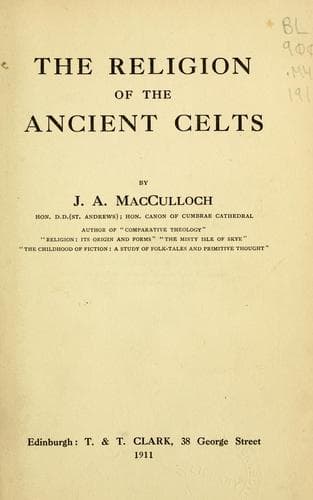
The Religion of the Ancient CeltsMacCulloch, J. A. (John Arnott)
Religion
The Religion of the Ancient Celts
MacCulloch, J. A. (John Arnott)
Celts -- Religion; Mythology, Celtic
While our knowledge of the Tuatha Dé Danann is based upon a series of
mythic tales and other records, that of the gods of the continental
Celts, apart from a few notices in classical authors and elsewhere,
comes from inscriptions. But as far as can be judged, though the names
of the two groups seldom coincide, their functions must have been much
alike, and their origins certainly the same. The Tuatha Dé Danann were
nature divinities of growth, light, agriculture--their symbols and
possessions suggesting fertility, e.g. the cauldron. They were
divinities of culture and crafts, and of war. There must have been many
other gods in Ireland than those described here, while some of those may
not have been worshipped all over Ireland. Generally speaking, there
were many local gods in Gaul with similar functions but different names,
and this may have been true of Ireland. Perhaps the different names
given to Dagda, Manannan, and others were simply names of similar local
gods, one of whom became prominent, and attracted to himself the names
of the others. So, too, the identity of Danu and Brigit might be
explained, or the fact that there were three Brigits. We read also in
the texts of the god of Connaught, or of Ulster, and these were
apparently regional divinities, or of "the god of Druidism"--perhaps a
god worshipped specially by Druids.[324] The remote origin of some of
these divinities may be sought in the primitive cult of the Earth
personified as a fertile being, and in that of vegetation and
corn-spirits, and the vague spirits of nature in all its aspects. Some
of these still continued to be worshipped when the greater gods had been
evolved. Though animal worship was not lacking in Ireland, divinities
who are anthropomorphic forms of earlier animal-gods are less in
evidence than on the Continent. The divinities of culture, crafts, and
war, and of departments of nature, must have slowly assumed the definite
personality assigned them in Irish religion. But, doubtless, they
already possessed that before the Goidels reached Ireland. Strictly
speaking, the underground domain assigned later to the Tuatha Dé Danann
belongs only to such of them as were associated with fertility. But in
course of time most of the group, as underground dwellers, were
connected with growth and increase. These could be blighted by their
enemies, or they themselves could withhold them when their worshippers
offended them.[325]
Public-domain text, read in full here on John Shaqi.
Reviews
Reviews
No reviews yet
Be the first to share your thoughts on this work.
Elsewhere in the archive
Join the Discussion
Join the discussion
Sign in to leave a comment or review.
Sign InorCreate an account