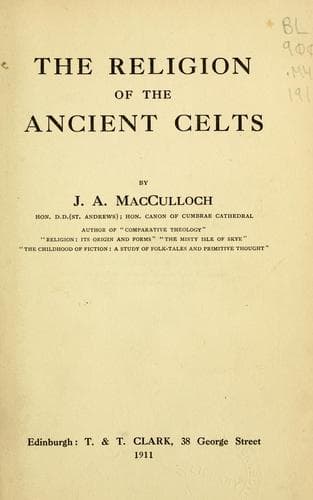
The Religion of the Ancient CeltsMacCulloch, J. A. (John Arnott)
Religion
The Religion of the Ancient Celts
MacCulloch, J. A. (John Arnott)
Celts -- Religion; Mythology, Celtic
Irish mythology points to the early pre-eminence of goddesses. As
agriculture and many of the arts were first in the hands of women,
goddesses of fertility and culture preceded gods, and still held their
place when gods were evolved. Even war-goddesses are prominent in
Ireland. Celtic gods and heroes are often called after their mothers,
not their fathers, and women loom largely in the tales of Irish
colonisation, while in many legends they play a most important part.
Goddesses give their name to divine groups, and, even where gods are
prominent, their actions are free, their personalities still clearly
defined. The supremacy of the divine women of Irish tradition is once
more seen in the fact that they themselves woo and win heroes; while
their capacity for love, their passion, their eternal youthfulness and
beauty are suggestive of their early character as goddesses of
ever-springing fertility.[326]
This supremacy of goddesses is explained by Professor Rh[^y]s as
non-Celtic, as borrowed by the Celts from the aborigines.[327] But it is
too deeply impressed on the fabric of Celtic tradition to be other than
native, and we have no reason to suppose that the Celts had not passed
through a stage in which such a state of things was normal. Their innate
conservatism caused them to preserve it more than other races who had
long outgrown such a state of things.
FOOTNOTES:
[199] _HL_ 89; Stokes, _RC_ xii. 129. D'Arbois, ii. 125, explains it as
"Folk of the god whose mother is called Danu."
[200] _RC_ xii. 77. The usual Irish word for "god" is _dia_; other names
are _Fiadu_, _Art_, _Dess_.
[201] See Joyce, _SII_. i. 252, 262; _PN_ i. 183.
[202] _LL_ 245_b_.
[203] _LL_ 11.
[204] _LL_ 127. The mounds were the sepulchres of the euhemerised gods.
[205] _Book of Fermoy_, fifteenth century.
[206] _LL_ 11_b_.
[207] _IT_ i. 14, 774; Stokes, _TL_ i. 99, 314, 319. _Síd_ is a fairy
hill, the hill itself or the dwelling within it. Hence those who dwell
in it are _Aes_ or _Fir síde_, "men of the mound," or _síde_, fairy
folk. The primitive form is probably _sêdos_, from _sêd_, "abode" or
"seat"; cf. Greek [Greek: edos] "a temple." Thurneysen suggests a
connection with a word equivalent to Lat. _sidus_, "constellation," or
"dwelling of the gods."
[208] Joyce, _SH_ i. 252; O'Curry, _MS. Mat._ 505.
[209] "Vision of Oengus," _RC_ iii. 344; _IT_ i. 197 f.
[210] Windisch, _Ir. Gram._ 118; O'Curry, _MC_ ii. 71; see p. 363,
_infra_.
[211] Windisch, _Ir. Gram._ 118, § 6; _IT_ iii. 407; _RC_ xvi. 139.
[212] Shore, _JAI_ xx. 9.
[213] Rh[^y]s, _HL_ 203 f. _Pennocrucium_ occurs in the _Itinerary_ of
Antoninus.
[214] Keating, 434.
[215] Joyce, _SH_ i. 252.
Public-domain text, read in full here on John Shaqi.
Reviews
Reviews
No reviews yet
Be the first to share your thoughts on this work.
Elsewhere in the archive
Join the Discussion
Join the discussion
Sign in to leave a comment or review.
Sign InorCreate an account