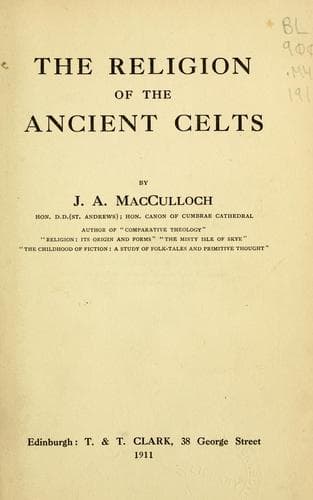
The Religion of the Ancient CeltsMacCulloch, J. A. (John Arnott)
Religion
The Religion of the Ancient Celts
MacCulloch, J. A. (John Arnott)
Celts -- Religion; Mythology, Celtic
[216] See p. 228. In Scandinavia the dead were called elves, and lived
feasting in their barrows or in hills. These became the seat of
ancestral cults. The word "elf" also means any divine spirit, later a
fairy. "Elf" and _síde_ may thus, like the "elf-howe" and the _síd_ or
mound, have a parallel history. See Vigfusson-Powell, _Corpus Poet.
Boreale_, i. 413 f.
[217] Tuan MacCairill (_LU_ 166) calls the Tuatha Déa, "dée ocus andée,"
and gives the meaning as "poets and husbandmen." This phrase, with the
same meaning, is used in "Cóir Anmann" (_IT_ iii. 355), but there we
find that it occurred in a pagan formula of blessing--"The blessing of
gods and not-gods be on thee." But the writer goes on to say--"These
were their gods, the magicians, and their non-gods, the husbandmen."
This may refer to the position of priest-kings and magicians as gods.
Rh[^y]s compares Sanskrit _deva_ and _adeva_ (_HL_ 581). Cf. the phrase
in a Welsh poem (Skene, i. 313), "Teulu Oeth et Anoeth," translated by
Rh[^y]s as "Household of Power and Not-Power" (_CFL_ ii. 620), but the
meaning is obscure. See Loth, i. 197.
[218] _LL_ 10_b_.
[219] Cormac, 4. Stokes (_US_ 12) derives Anu from _(p)an_, "to
nourish"; cf. Lat. _panis_.
[220] _Leicester County Folk-lore_, 4. The _Cóir Anmann_ says that Anu
was worshipped as a goddess of plenty (_IT_ iii. 289).
[221] Rh[^y]s, _Trans. 3rd Inter. Cong. Hist. of Rel._ ii. 213. See
Grimm, _Teut. Myth._ 251 ff., and p. 275, _infra_.
[222] Rh[^y]s, _ibid._ ii. 213. He finds her name in the place-name
_Bononia_ and its derivatives.
[223] Cormac, 23.
[224] Cæsar, vi. 17; Holder, _s.v._; Stokes, _TIG_ 33.
[225] Girald. Cambr. _Top. Hib._ ii. 34 f. Vengeance followed upon rash
intrusion. For the breath tabu see Frazer, _Early Hist. of the
Kingship_, 224.
[226] Joyce, _SH_ i. 335.
[227] P. 41, _supra_.
[228] Martin, 119; Campbell, _Witchcraft_, 248.
[229] Frazer, _op. cit._ 225.
[230] Joyce, _PN_ i. 195; O'Grady, ii. 198; Wood-Martin, i. 366; see p.
42, _supra_.
[231] Fitzgerald, _RC_ iv. 190. Aine has no connection with Anu, nor is
she a moon-goddess, as is sometimes supposed.
[232] _RC_ iv. 189.
[233] Keating, 318; _IT_ iii. 305; _RC_ xiii. 435.
[234] O'Grady, ii. 197.
[235] _RC_ xii. 109, xxii. 295; Cormac, 87; Stokes, _TIG_ xxxiii.
[236] Holder, i. 341; _CIL_ vii. 1292; Cæsar, ii. 23.
[237] _LL_ 11_b_; Cormac, s.v. _Neit_; _RC_ iv. 36; _Arch. Rev._ i. 231;
Holder, ii. 714, 738.
[238] Stokes, _TIG, LL_ 11_a_.
[239] Rh[^y]s, _HL_ 43; Stokes, _RC_ xii. 128.
[240] _RC_ xii. 91, 110.
[241] See p. 131.
[242] Petrie, _Tara_, 147; Stokes, _US_ 175; Meyer, _Cath Finntrága_,
Oxford, 1885, 76 f.; _RC_ xvi. 56, 163, xxi. 396.
[243] _CIL_ vii. 507; Stokes, _US_ 211.
[244] _RC_ i. 41, xii. 84.
Public-domain text, read in full here on John Shaqi.
Reviews
Reviews
No reviews yet
Be the first to share your thoughts on this work.
Elsewhere in the archive
Join the Discussion
Join the discussion
Sign in to leave a comment or review.
Sign InorCreate an account