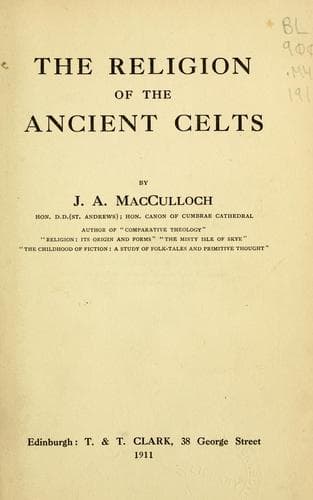
The Religion of the Ancient CeltsMacCulloch, J. A. (John Arnott)
Religion
The Religion of the Ancient Celts
MacCulloch, J. A. (John Arnott)
Celts -- Religion; Mythology, Celtic
The story of Branwen is similar to a tale of which there are variants in
Teutonic and Scandinavian sagas, but the resemblance is closer to the
latter.[339] Possibly a similar story with their respective divinities
or heroes for its characters existed among Celts, Teutons, and Norsemen,
but more likely it was borrowed from Norsemen who occupied both sides of
the Irish Sea in the ninth and tenth century, and then naturalised by
furnishing it with Celtic characters. But into this framework many
native elements were set, and we may therefore scrutinise the story for
Celtic mythical elements utilised by its redactor, who probably did not
strip its Celtic personages of their earlier divine attributes. In the
two _Mabinogi_ these personages are Llyr, his sons Bran and Manawyddan,
his daughter Branwen, their half-brothers Nissyen and Evnissyen, sons of
Llyr's wife Penardim, daughter of Beli, by a previous marriage with
Eurosswyd.
Llyr is the equivalent of the Irish Ler, the sea-god, but two other
Llyrs, probably duplicates of himself, are known to Welsh story--Llyr
Marini, and the Llyr, father of Cordelia, of the chroniclers.[340] He is
constantly confused with Lludd Llawereint, e.g. both are described as
one of three notable prisoners of Britain, and both are called fathers
of Cordelia or Creiddylad.[341] Perhaps the two were once identical, for
Manannan is sometimes called son of Alloid (= Lludd), in Irish texts, as
well as son of Ler.[342] But the confusion may be accidental, nor is it
certain that Nodons or Lludd was a sea-god. Llyr's prison was that of
Eurosswyd,[343] whose wife he may have abducted and hence suffered
imprisonment. In the _Black Book of Caermarthen_ Bran is called son of Y
Werydd or "Ocean," according to M. Loth's interpretation of the name,
which would thus point to Llyr's position as a sea-god. But this is
contested by Professor Rh[^y]s who makes Ywerit wife of Llyr, the name
being in his view a form of the Welsh word for Ireland. In Geoffrey and
the chroniclers Llyr becomes a king of Britain whose history and that of
his daughters was immortalised by Shakespeare. Geoffrey also refers to
Llyr's burial in a vault built in honour of Janus.[344] On this
Professor Rh[^y]s builds a theory that Llyr was a form of the Celtic Dis
with two faces and ruler of a world of darkness.[345] But there is no
evidence that the Celtic Dispater was lord of a gloomy underworld, and
it is best to regard Llyr as a sea-divinity.
Public-domain text, read in full here on John Shaqi.
Reviews
Reviews
No reviews yet
Be the first to share your thoughts on this work.
Elsewhere in the archive
Join the Discussion
Join the discussion
Sign in to leave a comment or review.
Sign InorCreate an account