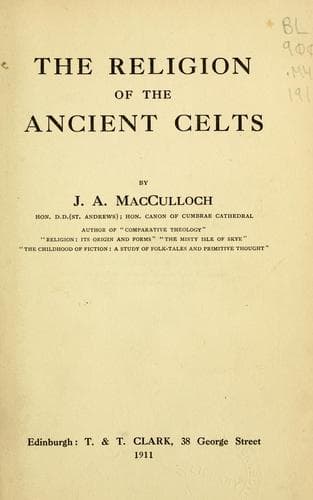
The Religion of the Ancient CeltsMacCulloch, J. A. (John Arnott)
Religion
The Religion of the Ancient Celts
MacCulloch, J. A. (John Arnott)
Celts -- Religion; Mythology, Celtic
Manawyddan is not god-like in these tales in the sense in which the
majestic Manannan of Irish story is, though elsewhere we learn that
"deep was his counsel."[346] Though not a magician, he baffles one of
the great wizards of Welsh story, and he is also a master craftsman, who
instructs Pryderi in the arts of shoe-making, shield-making, and
saddlery. In this he is akin to Manannan, the teacher of Diarmaid.
Incidents of his career are reflected in the _Triads_, and his union
with Rhiannon may point to an old myth in which they were from the first
a divine pair, parents of Pryderi. This would give point to his
deliverance of Pryderi and Rhiannon from the hostile magician.[347]
Rhiannon resembles the Irish Elysium goddesses, and Manawyddan, like
Manannan, is lord of Elysium in a _Taliesin_ poem.[348] He is a
craftsman and follows agriculture, perhaps a reminiscence of the old
belief that fertility and culture come from the god's land. Manawyddan,
like other divinities, was drawn into the Arthurian cycle, and is one of
those who capture the famous boar, the _Twrch Trwyth_.[349]
Bran, or Bendigeit Vran ("Bran the Blessed"), probably an old pagan
title which appropriately enough denotes one who figured later in
Christian hagiology, is so huge that no house or ship can hold him.
Hence he wades over to Ireland, and as he draws near is thought to be a
mountain. This may be an archaic method of expressing his divinity--a
gigantic non-natural man like some of the Tuatha Déa and Ossianic
heroes. But Bran also appears as the _Urdawl Ben_, or "Noble Head,"
which makes time pass to its bearers like a dream, and when buried
protects the land from invasion. Both as a giant squatting on a rock and
as a head, Bran is equated by Professor Rh[^y]s with Cernunnos, the
squatting god, represented also as a head, and also with the Welsh Urien
whose attribute was a raven, the supposed meaning of Bran's name.[350]
He further equates him with Uthr Ben, "Wonderful Head," the superior
bard, harper and piper of a _Taliesin_ poem.[351] Urien, Bran, and Uthr
are three forms of a god worshipped by bards, and a "dark" divinity,
whose wading over to Ireland signifies crossing to Hades, of which he,
like Yama, who first crossed the rapid waters to the land of death, is
the ruler.[352] But Bran is not a "dark" god in the sense implied here.
Cernunnos is god of a happy underworld, and there is nothing dark or
evil in him or in Bran and his congeners. Professor Rh[^y]s's "dark"
divinities are sometimes, in his view, "light" gods, but they cannot be
both. The Celtic lords of the dead had no "dark" character, and as gods
of fertility they were, so to speak, in league with the sun-god, the
slayer of Bran, according to Professor Rh[^y]s's ingenious theory. And
although to distracted Irish secretaries Ireland may be Hades, its
introduction into this _Mabinogi_ merely points to the interpretation of
a mythico-historic connection between Wales and Ireland. Thus if Bran is
Public-domain text, read in full here on John Shaqi.
Reviews
Reviews
No reviews yet
Be the first to share your thoughts on this work.
Elsewhere in the archive
Join the Discussion
Join the discussion
Sign in to leave a comment or review.
Sign InorCreate an account