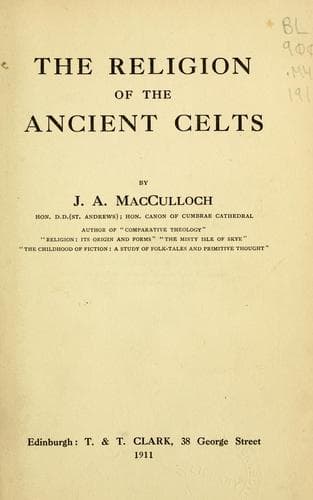
The Religion of the Ancient CeltsMacCulloch, J. A. (John Arnott)
Religion
The Religion of the Ancient Celts
MacCulloch, J. A. (John Arnott)
Celts -- Religion; Mythology, Celtic
Cernunnos, this is because he is a lord of the underworld of fertility,
the counterpart of which is the distant Elysium, to which Bran seems
rather to belong. Thus, in presence of his head, time passes as a dream
in feasting and joy. This is a true Elysian note, and the tabued door of
the story is also suggestive of the tabus of Elysium, which when broken
rob men of happiness.[353] As to the power of the head in protecting the
land, this points to actual custom and belief regarding the relics of
the dead and the power of divine images or sculptured heads.[354] The
god Bran has become a king and law-giver in the _Mabinogion_ and the
_Triads_,[355] while Geoffrey of Monmouth describes how Belinus and
Brennus, in the Welsh version Beli and Bran, dispute the crown of
Britain, are reconciled, and finally conquer Gaul and Rome.[356] The
mythic Bran is confused with Brennus, leader of the Gauls against Rome
in 390 B.C., and Belinus may be the god Belenos, as well as Beli, father
of Lludd and Caswallawn. But Bran also figures as a Christian
missionary. He is described as hostage at Rome for his son Caradawc,
returning thence as preacher of Christianity to the Cymry--a legend
arising out of a misunderstanding of his epithet "Blessed" and a
confusing of his son with the historic Caractacus.[357] Hence Bran's
family is spoken of as one of the three saintly families of Prydein, and
he is ancestor of many saints.[358]
Branwen, "White Bosom," daughter of a sea-god, may be a sea-goddess,
"Venus of the northern sea,"[359] unless with Mr. Nutt we connect her
with the cauldron described in her legend,[360] symbol of an orgiastic
cult, and regard her as a goddess of fertility. But the connection is
not clear in the story, though in some earlier myth the cauldron may
have been her property. As Brangwaine, she reappears in romance, giving
a love-potion to Tristram--perhaps a reminiscence of her former
functions as a goddess of love, or earlier of fertility. In the
_Mabinogion_ she is buried in Anglesey at Ynys Bronwen, where a cairn
with bones discovered in 1813 was held to be the grave and remains of
Branwen.[361]
Public-domain text, read in full here on John Shaqi.
Reviews
Reviews
No reviews yet
Be the first to share your thoughts on this work.
Elsewhere in the archive
Join the Discussion
Join the discussion
Sign in to leave a comment or review.
Sign InorCreate an account