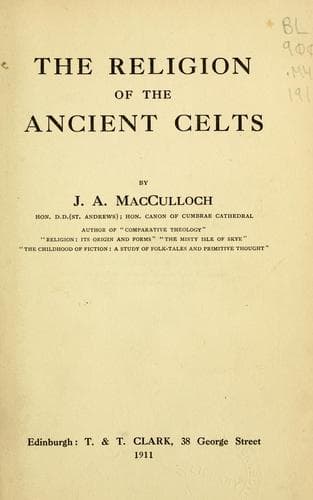
The Religion of the Ancient CeltsMacCulloch, J. A. (John Arnott)
Religion
The Religion of the Ancient Celts
MacCulloch, J. A. (John Arnott)
Celts -- Religion; Mythology, Celtic
The divine functions of Llew Llaw Gyffes are hardly apparent in the
_Mabinogi_. The incident of Blodeuwedd's unfaithfulness is simply that
of the _Märchen_ formula of the treacherous wife who discovers the
secret of her husband's life, and thus puts him at her lover's
mercy.[382] But since Llew is not slain, but changes to eagle form, this
unusual ending may mean that he was once a bird divinity, the eagle
later becoming his symbol. Some myth must have told of his death, or he
was afterwards regarded as a mortal who died, for a poem mentions his
tomb, and adds, "he was a man who never gave justice to any one." Dr.
Skene suggests that truth, not justice, is here meant, and finds in this
a reference to Llew's disguises.[383] Professor Rh[^y]s, for reasons not
held convincing by M. Loth, holds that _Llew_, "lion," was a
misapprehension for his true name _Lleu_, interpreted by him
"light."[384] This meaning he also gives to _Lug_, equating Lug and
Llew, and regarding both as sun-gods. He also equates _Llaw Gyffes_,
"steady _or_ strong hand," with Lug's epithet _Lám fada_, "long hand,"
suggesting that _gyffes_ may have meant "long," although it was Llew's
steadiness of hand in shooting which earned him the title.[385] Again,
Llew's rapid growth need not make him the sun, for this was a privilege
of many heroes who had no connection with the sun. Llew's unfortunate
matrimonial affairs are also regarded as a sun myth. Blodeuwedd is a
dawn goddess dividing her love between the sun-god and the prince of
darkness. Llew as the sun is overcome by the latter, but is restored by
the culture-hero Gwydion, who slays the dark rival. The transformation
of Blodeuwedd into an owl means that the Dawn has become the Dusk.[386]
As we have seen, all this is a _Märchen_ formula with no mythical
significance. Evidence of the precariousness of such an interpretation
is furnished from the similar interpretation of the story of Curoi's
wife, Blathnat, whose lover Cúchulainn slew Curoi.[387] Here a supposed
sun-god is the treacherous villain who kills a dark divinity, husband of
a dawn goddess.
Public-domain text, read in full here on John Shaqi.
Reviews
Reviews
No reviews yet
Be the first to share your thoughts on this work.
Elsewhere in the archive
Join the Discussion
Join the discussion
Sign in to leave a comment or review.
Sign InorCreate an account