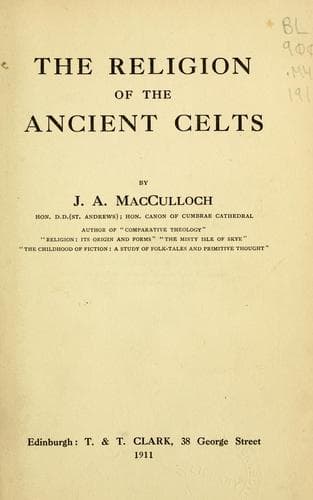
The Religion of the Ancient CeltsMacCulloch, J. A. (John Arnott)
Religion
The Religion of the Ancient Celts
MacCulloch, J. A. (John Arnott)
Celts -- Religion; Mythology, Celtic
If Llew is a sun-god, the equivalent of Lug, it is curious that he is
never connected with the August festival in Wales which corresponds to
Lugnasad in Ireland. There may be some support to the theory which makes
him a sun-god in a _Triad_ where he is one of the three _ruddroawc_ who
cause a year's sterility wherever they set their feet, though in this
Arthur excels them, for he causes seven years' sterility![388] Does this
point to the scorching of vegetation by the summer sun? The mythologists
have not made use of this incident. On the whole the evidence for Llew
as a sun-god is not convincing. The strongest reason for identifying him
with Lug rests on the fact that both have uncles who are smiths and have
similar names--Govannon and Gavida (Goibniu). Like Amæthon, Govannon,
the artificer or smith (_gôf_, "smith"), is mentioned in _Kulhwych_ as
one whose help must be gained to wait at the end of the furrows to
cleanse the iron of the plough.[389] Here he is brought into connection
with the plough, but the myth to which the words refer is lost. A
_Taliesin_ poem associates him with Math--"I have been with artificers,
with the old Math and with Govannon," and refers to his _Caer_ or
castle.[390]
Arianrhod, "silver wheel," has a twofold character. She pretends to be a
virgin, and disclaims all knowledge of her son Llew, yet she is mistress
of Gwydion. In the _Triads_ she appears as one of the three blessed (or
white) ladies of Britain.[391] Perhaps these two aspects of her
character may point to a divergence between religion and mythology, the
cult of a virgin goddess of whom myth told discreditable things. More
likely she was an old Earth-goddess, at once a virgin and a fruitful
mother, like Artemis, the virgin goddess, yet neither chaste nor fair,
or like a Babylonian goddess addressed as at once "mother, wife, and
maid." Arianrhod, "beauty famed beyond summer's dawn," is mentioned in a
_Taliesin_ poem, and she was later associated with the constellation
Corona Borealis.[392] Possibly her real name was forgotten, and that of
Arianrhod derived from a place-name, "Caer Arianrhod," associated with
her. The interpretation which makes her a dawn goddess, mother of light,
Lleu, and darkness, Dylan, is far from obvious.[393] Dylan, after his
baptism, rushed into the sea, the nature of which became his. No wave
ever broke under him; he swam like a fish; and hence was called Dylan
Eil Ton or "son of the wave." Govannon, his uncle, slew him, an incident
interpreted as the defeat of darkness, which "hies away to lurk in the
sea." Dylan, however, has no dark traits and is described as a blonde.
The waves lament his death, and, as they dash against the shore, seek to
avenge it. His grave is "where the wave makes a sullen sound," but
popular belief identifies him with the waves, and their noise as they
press into the Conway is his dying groan. Not only is he _Eil Ton_, "son
of the wave," but also _Eil Mor_, "son of the sea."[394] He is thus a
Public-domain text, read in full here on John Shaqi.
Reviews
Reviews
No reviews yet
Be the first to share your thoughts on this work.
Elsewhere in the archive
Join the Discussion
Join the discussion
Sign in to leave a comment or review.
Sign InorCreate an account