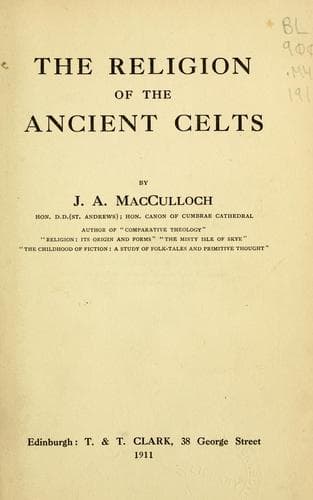
The Religion of the Ancient CeltsMacCulloch, J. A. (John Arnott)
Religion
The Religion of the Ancient Celts
MacCulloch, J. A. (John Arnott)
Celts -- Religion; Mythology, Celtic
Another group, unknown to the _Mabinogion_, save that Taliesin is one of
the bearers of Bran's head, is found in the _Book of Taliesin_ and in
the late story of Taliesin. These, like the _Arthur_ cycle, often refer
to personages of the _Mabinogion_; hence we gather that local groups of
gods, originally distinct, were later mingled in story, the references
in the poems reflecting this mingling. Late as is the _Hanes Taliesin_
or story of Taliesin, and expressed as much of it is in a _Märchen_
formula, it is based on old myths about Cerridwen and Taliesin of which
its compiler made use, following an old tradition already stereotyped in
one of the poems in the _Märchen_ formula of the Transformation
Combat.[419] But the mythical fragments are also mingled with traditions
regarding the sixth century poet Taliesin. The older saga was perhaps
developed in a district south of the Dyfi estuary.[420] In Lake Tegid
dwell Tegid Voel, Cerridwen, and their children--the fair maiden
Creirwy, Morvran, and the ugly Avagddu. To give Avagddu knowledge, his
mother prepares a cauldron of inspiration from which three drops of
inspiration will be produced. These fall on the finger of Gwion, whom
she set to stir it. He put the finger in his mouth, and thus acquired
the inspiration. He fled, and Cerridwen pursued, the rest of the story
being accommodated to the Transformation Combat formula. Finally,
Cerridwen as a hen swallows Gwion as a grain of wheat, and bears him as
a child, whom she throws into the sea. Elphin, who rescues him, calls
him Taliesin, and brings him up as a bard.[421]
The water-world of Tegid is a submarine Elysium with the customary
cauldron of inspiration, regeneration, and fertility, like the cauldron
associated with a water-world in the _Mabinogion_. "Shall not my chair
be defended from the cauldron of Cerridwen," runs a line in a Taliesin
poem, while another speaks of her chair, which was probably in Elysium
like that of Taliesin himself in Caer Sidi.[422] Further references to
her connection with poetry show that she may have been worshipped by
bards, her cauldron being the source of their inspiration.[423] Her
anger at Gwion may point to some form of the Celtic myth of the theft of
the elements of culture from the gods' land. But the cauldron was first
of all associated with a fertility cult,[424] and Cerridwen must
therefore once have been a goddess of fertility, who, like Brigit, was
later worshipped by bards. She may also have been a corn-goddess, since
she is called a goddess of grain, and tradition associates the pig--a
common embodiment of the corn-spirit--with her.[425] If the tradition is
correct, this would be an instance, like that of Demeter and the pig, of
an animal embodiment of the corn-spirit being connected with a later
anthropomorphic corn-goddess.
Public-domain text, read in full here on John Shaqi.
Reviews
Reviews
No reviews yet
Be the first to share your thoughts on this work.
Elsewhere in the archive
Join the Discussion
Join the discussion
Sign in to leave a comment or review.
Sign InorCreate an account