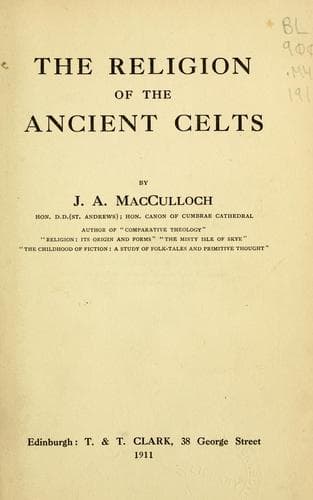
The Religion of the Ancient CeltsMacCulloch, J. A. (John Arnott)
Religion
The Religion of the Ancient Celts
MacCulloch, J. A. (John Arnott)
Celts -- Religion; Mythology, Celtic
Taliesin was probably an old god of poetic inspiration confused with the
sixth century poet of the same name, perhaps because this boastful poet
identified himself or was identified by other bards with the gods. He
speaks of his "splendid chair, inspiration of fluent and urgent song" in
Caer Sidi or Elysium, and, speaking in the god's name or identifying
himself with him, describes his presence with Llew, Bran, Gwydion, and
others, as well as his creation and his enchantment before he became
immortal.[426] He was present with Arthur when a cauldron was stolen
from Aunwfn, and basing his verses on the mythic transformations and
rebirths of the gods, recounts in highly inflated language his own
numerous forms and rebirths.[427] His claims resemble those of the
_Shaman_ who has the entree of the spirit-world and can transform
himself at will. Taliesin's rebirth is connected with his acquiring of
inspiration. These incidents appear separately in the story of Fionn,
who acquired his inspiration by an accident, and was also said to have
been reborn as Mongan. They are myths common to various branches of the
Celtic people, and applied in different combinations to outstanding gods
or heroes.[428] The _Taliesin_ poems show that there may have been two
gods or two mythic aspects of one god, later combined together. He is
the son of the goddess and dwells in the divine land, but he is also a
culture-hero stealing from the divine land. Perhaps the myths reflect
the encroachment of the cult of a god on that of a goddess, his
worshippers regarding him as her son, her worshippers reflecting their
hostility to the new god in a myth of her enmity to him. Finally, the
legend of the rescue of Taliesin the poet from the waves became a myth
of the divine outcast child rescued by Elphin, and proving himself a
bard when normal infants are merely babbling.
The occasional and obscure references to the other members of this group
throw little light on their functions, save that Morvran, "sea-crow," is
described in _Kulhwych_ as so ugly and terrible that no one would strike
him at the battle of Camlan. He may have been a war-god, like the
scald-crow goddesses of Ireland, and he is also spoken of in the
_Triads_ as an "obstructor of slaughter" or "support of battle."[429]
Public-domain text, read in full here on John Shaqi.
Reviews
Reviews
No reviews yet
Be the first to share your thoughts on this work.
Elsewhere in the archive
Join the Discussion
Join the discussion
Sign in to leave a comment or review.
Sign InorCreate an account