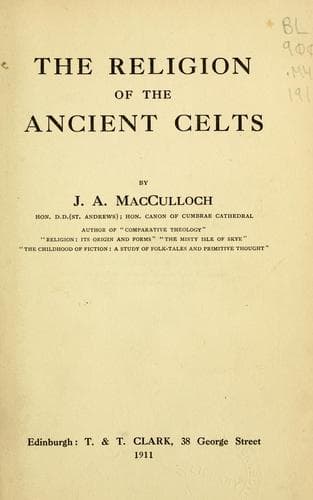
The Religion of the Ancient CeltsMacCulloch, J. A. (John Arnott)
Religion
The Religion of the Ancient Celts
MacCulloch, J. A. (John Arnott)
Celts -- Religion; Mythology, Celtic
The boastful Kei of the romances appears already in _Kulhwych_, while in
Geoffrey he is Arthur's seneschal.[440] Nobler traits are his in later
Welsh poetry; he is a mighty warrior, fighting even against a hundred,
though his powers as a toper are also great. Here, too, his death is
lamented.[441] He may thus have been a god of war, and his battle-fury
may be poetically described in a curious passage referring to him in
_Kulhwych_: "His breath lasted nine days and nine nights under water. He
could remain without sleep for the same period. No physician could heal
a wound inflicted by his sword. When he pleased he could make himself as
tall as the tallest tree in the wood. And when it rained hardest,
whatever he carried remained dry above and below his hand to the
distance of a handbreadth, so great was his natural heat. When it was
coldest he was as glowing fuel to his companions."[442] This almost
exactly resembles Cúchulainn's aspect in his battle-fury. In a curious
poem Gwenhyvar (Guinevere) extols his prowess as a warrior above that of
Arthur, and in _Kulhwych_ and elsewhere there is enmity between the
two.[443] This may point to Kei's having been a god of tribes hostile to
those of whom Arthur was hero.
Mabon, one of Arthur's heroes in _Kulhwych_ and the _Dream of Rhonabwy_,
whose name, from _mab_ (_map_), means "a youth," may be one with the god
Maponos equated with Apollo in Britain and Gaul, perhaps as a god of
healing springs.[444] His mother's name, Modron, is a local form of
_Matrona_, a river-goddess and probably one of the mother-goddesses as
her name implies. In the _Triads_ Mabon is one of the three eminent
prisoners of Prydein. To obtain his help in hunting the magic boar his
prison must be found, and this is done by animals, in accordance with a
_Märchen_ formula, while the words spoken by them show the immense
duration of his imprisonment--perhaps a hint of his immortality.[445]
But he was also said to have died and been buried at Nantlle,[446]
which, like Gloucester, the place of his prison, may have been a site of
his widely extended cult.[447]
* * * * *
Taken as a whole the various gods and heroes of the Brythons, so far as
they are known to us, just as they resemble the Irish divinities in
having been later regarded as mortals, magicians, and fairies, so they
resemble them in their functions, dimly as these are perceived. They are
associated with Elysium, they are lords of fertility and growth, of the
sea, of the arts of culture and of war. The prominent position of
certain goddesses may point to what has already been discovered of them
in Gaul and Ireland--their pre-eminence and independence. But, like the
divinities of Gaul and Ireland, those of Wales were mainly local in
character, and only in a few cases attained a wider popularity and cult.
Public-domain text, read in full here on John Shaqi.
Reviews
Reviews
No reviews yet
Be the first to share your thoughts on this work.
Elsewhere in the archive
Join the Discussion
Join the discussion
Sign in to leave a comment or review.
Sign InorCreate an account