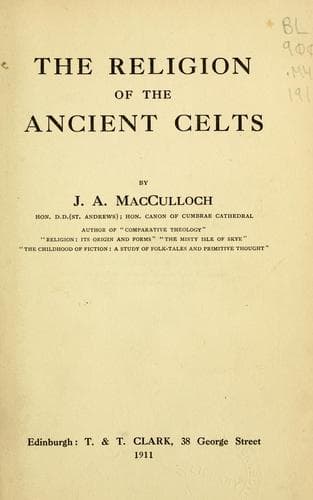
The Religion of the Ancient CeltsMacCulloch, J. A. (John Arnott)
Religion
The Religion of the Ancient Celts
MacCulloch, J. A. (John Arnott)
Celts -- Religion; Mythology, Celtic
Merlin, or Myrddin, appears in the romances as a great magician who is
finally overcome by the Lady of the Lake, and is in Geoffrey son of a
mysterious invisible personage who visits a woman, and, finally taking
human shape, begets Merlin. As a son who never had a father he is chosen
as the foundation sacrifice for Vortigern's tower by his magicians, but
he confutes them and shows why the tower can never be built, namely,
because of the dragons in the pool beneath it. Then follow his
prophecies regarding the dragons and the future of the country, and the
story of his removal of the Giant's Dance, or Stonehenge, from Ireland
to its present site--an ætiological myth explaining the origin of the
great stone circle. His description of how the giants used the water
with which they washed the stones for the cure of sickness or wounds,
probably points to some ritual for healing in connection with these
megaliths. Finally, we hear of his transformation of the lovelorn Uther
and of his confidant Ulfin, as well as of himself.[438] Here he appears
as little more than an ideal magician, possibly an old god, like the
Irish "god of Druidism," to whose legend had been attached a story of
supernatural conception. Professor Rh[^y]s regards him as a Celtic Zeus
or as the sun, because late legends tell of his disappearance in a glass
house into the sea. The glass house is the expanse of light travelling
with the sun (Merlin), while the Lady of the Lake who comes daily to
solace Merlin in his enchanted prison is a dawn-goddess. Stonehenge was
probably a temple of this Celtic Zeus "whose late legendary self we have
in Merlin."[439] Such late romantic episodes and an ætiological myth can
hardly be regarded as affording safe basis for these views, and their
mythological interpretation is more than doubtful. The sun is never
prisoner of the dawn as Merlin is of Viviane. Merlin and his glass house
disappear for ever, but the sun reappears every morning. Even the most
poetic mythology must conform in some degree to actual phenomena, but
this cannot be said of the systems of mythological interpretation. If
Merlin belongs to the pagan period at all, he was probably an ideal
magician or god of magicians, prominent, perhaps, in the Arthur saga as
in the later romances, and credited with a mysterious origin and an
equally mysterious ending, the latter described in many different ways.
Public-domain text, read in full here on John Shaqi.
Reviews
Reviews
No reviews yet
Be the first to share your thoughts on this work.
Elsewhere in the archive
Join the Discussion
Join the discussion
Sign in to leave a comment or review.
Sign InorCreate an account