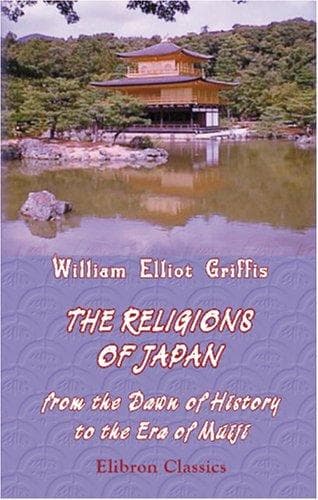
The Religions of Japan, from the Dawn of History to the Era of MéijiGriffis, William Elliot
Religion
The Religions of Japan, from the Dawn of History to the Era of Méiji
Griffis, William Elliot
Japan -- Religion
Certain it is that during the revival of Pure Shintō in the
eighteenth century, the scholars of the Shintō school, and those of
its great rival, the Chinese, agreed in making loyalty[13] take the
place of filial duty in the Confucian system. To serve the cause of the
Emperor became the most essential duty to those with cultivated minds.
The newer Chinese philosophy mightily influenced the historians, Rai
Sanyo and those of the Mito school, whose works, now classic, really
began the revolution of 1868. By forming and setting in motion the
public opinion, which finally overthrew the Shōgun and feudalism,
restored the Emperor to supreme power, and unified the nation, they
helped, with modern ideas, to make the New Japan of our day. The
Shintō and the Chinese teachings became amalgamated in a common
cause, and thus the philosophy of Chu Hi, mingling with the nationalism
and patriotism inculcated by Shintō, brought about a remarkable
result. As a native scholar and philosopher observes, "It certainly is
strange to see the Tokugawa rule much shaken, if not actually
overthrown, by that doctrine which generations of able Shōguns and
their ministers had earnestly encouraged and protected. It is perhaps
still more remarkable to see the Mito clan, under many able and active
chiefs, become the centre of the Kinno[14] movement, which was to result
in the overthrow of the Tokugawa family, of which it was itself a
branch."
A Medley of Pantheism.
The philosophy of modern Confucianism is wholly pantheistic. There is in
it no such thing or being as God. The orthodox pantheism of Old Japan
means that everything in general is god, but nothing in particular is
God; that All is god, but not that God is all. It is a "pantheistic
medley."[15]
Chu Hi and his Japanese successors, especially Kyū-so, argue finely
and discourse volubly about _Ki_[16] or spirit; but it is not Spirit, or
spiritual in the sense of Him who taught even a woman at the well-curb
at Sychar. It is in the air. It is in the earth, the trees, the flowers.
It comes to consciousness in man. His _Ri_ is the Tao of Lao Tsze, the
Way, Reason, Law. It is formless, invisible.
"Ri is not separate from Ki, for then it were an empty abstract
thing. It is joined to Ki, and may be called, by nature, one
decreed, changeless Norm. It is the rule of Ki, the very centre,
the reason why Ki is Ki."
Ten or Heaven is not God or the abode of God, but an abstraction, a sort
of Unknowable, or Primordial Necessity.
Public-domain text, read in full here on John Shaqi.
Reviews
Reviews
No reviews yet
Be the first to share your thoughts on this work.
Elsewhere in the archive
Join the Discussion
Join the discussion
Sign in to leave a comment or review.
Sign InorCreate an account