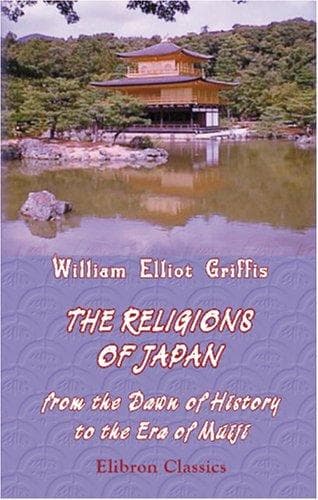
The Religions of Japan, from the Dawn of History to the Era of MéijiGriffis, William Elliot
Religion
The Religions of Japan, from the Dawn of History to the Era of Méiji
Griffis, William Elliot
Japan -- Religion
"The doctrine of the Sages knows and worships Heaven, and
without faith in it there is no truth. For men and things, the
universe, are born and nourished by Heaven, and the 'Way,' the
'ri,' that is in all, is the 'Way,' the 'ri' of Heaven.
Distinguishing root and branch, the heart is the root of Heaven
and the appearance, the revolution of the sun and moon, the
order of the stars, is the branch. The books of the sages teach
us to conform to the heart of Heaven and deal not with
appearances."
"The teaching of the sages is the original truth and, given to
men, it forms both their nature and their relationships. With it
complete, naught else is needed for the perfect following of the
'Way.' Let then the child make its parents Heaven, the retainer,
his Lord, the wife her husband, and let each give up life for
righteousness. Thus will each serve for Heaven. But if we exalt
Heaven above parent or Lord, we shall come to think we can serve
it though they be disobeyed and like tiger or wolf shall rejoice
to kill them. To such fearful end does the Western learning
lead.... Let each one die for duty, there is naught else we can
do."
Thus wrote Ohashi Junzo, as late as 1857 A.D., the same year in which
Townsend Harris entered Yedo to teach the practical philosophy of
Christendom, and the brotherhood of man as expressed in diplomacy.
Ohashi Junzo bitterly opposed the opening of Japan to modern
civilization and the ideas of Christendom. His book was the swan-song of
the dying Japanese Confucianism. Slow as is the dying, and hard as its
death may be, the mind of new Japan has laid away to dust and oblivion
the Téi-shu philosophy. "At present they (the Chinese classics) have
fallen into almost total neglect, though phrases and allusions borrowed
from them still pass current in literature, and even to some extent in
the language of every-day life." Séido, the great temple of Confucius in
Tokyo, is now utilized as an educational Museum.[17]
A study of this subject and of comparative religion, is of immediate
practical benefit to the Christian teacher. The preacher, addressing an
audience made up of educated Japanese, who speaks of God without
describing his personality, character, or attributes as illustrated in
Revelation, will find that his hearers receive his term as the
expression for a bundle of abstract principles, or a system of laws, or
some kind of regulated force. They do, indeed, make some reference to a
"creator" by using a rare word. Occasionally, their language seems to
touch the boundary line on the other side of which is conscious
intelligence, but nothing approaching the clearness and definiteness of
the early Chinese monotheism of the pre-Confucian classics is to be
distinguished.[18] The modern Japanese long ago heard joyfully the
words, "Honor the gods, but keep them far from you," and he has done it.
Public-domain text, read in full here on John Shaqi.
Reviews
Reviews
No reviews yet
Be the first to share your thoughts on this work.
Elsewhere in the archive
Join the Discussion
Join the discussion
Sign in to leave a comment or review.
Sign InorCreate an account