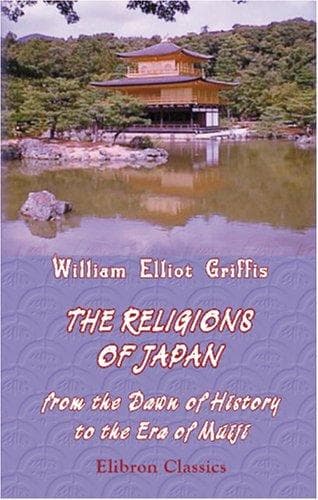
The Religions of Japan, from the Dawn of History to the Era of MéijiGriffis, William Elliot
Religion
The Religions of Japan, from the Dawn of History to the Era of Méiji
Griffis, William Elliot
Japan -- Religion
All accounts in the vernacular Japanese agree, that their Butsu-dō or
Buddhism was imported from Korea. In the sixteenth year of Kéitai, the
twenty-seventh Mikado (of the list made centuries after, and the
eleventh after the impossible line of the long-lived or mythical
Mikados), A.D. 534, it is said that a man from China brought with him an
image of Buddha into Yamato, and setting it up in a thatched cottage
worshipped it. The people called it "foreign-country god." Visitors
discussed with him the religion of Shaka, as the Japanese call
Shakyamuni, and some little knowledge of Buddhism was gained, but no
notable progress was made until A.D. 552, which is generally accepted
and celebrated as the year of the introduction of the faith into Japan.
Then a king of Hiaksai in Korea, sent over to the court and to the
Mikado golden images of the Buddha and of the triad of "precious ones,"
with Sutras and sacred books. These holy relics are believed to be still
preserved in the famous temple of Zenkōji,[32] belonging to the
temple of the Tendai Sect at Nagano in Northern Japan, this shrine being
dedicated to Amida and his two followers Kwannon (Avalokitesvara) and
Dai-séi-shi (Mahastanaprapta). This group of idols, as the custodian of
the shrine will tell you, was made by Shaka himself out of gold, found
at the base of the tree which grows at the centre of the universe. After
remaining in Korea for eleven hundred and twelve years, it was brought
to Japan. Mighty is the stream of pilgrims which continually sets toward
the holy place. A common proverb declares that even a cow can find her
way thither.
In A.D. 572 and again in 584, new images, sutras and teachers came over
from another part of Korea. The Mikado called a council to determine
what should be done with the idols, to the worship of which he was
himself inclined; but a majority were against the idea of insulting the
native gods by receiving the presents and thus introducing a foreign
religion. The minister of state, however, one Soga no Inamé, expressed
himself in favor of Buddhism, and put the images in his country house
which he converted into a temple. When, soon after, the land was
afflicted with a pestilence, the opponents of the new faith attributed
it to the wrath of the gods at the hospitality given to the new idols.
War broke out, fighting took place, and the Buddhist temple was burned
and the idols thrown into the river, near Osaka. Great portents
followed, and the enemies of Buddhism were, it is said, burned up by
flames descending from heaven.
Public-domain text, read in full here on John Shaqi.
Reviews
Reviews
No reviews yet
Be the first to share your thoughts on this work.
Elsewhere in the archive
Join the Discussion
Join the discussion
Sign in to leave a comment or review.
Sign InorCreate an account