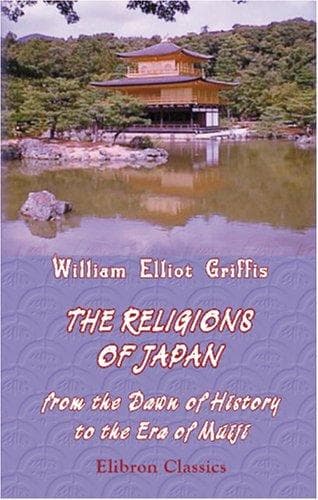
The Religions of Japan, from the Dawn of History to the Era of MéijiGriffis, William Elliot
Religion
The Religions of Japan, from the Dawn of History to the Era of Méiji
Griffis, William Elliot
Japan -- Religion
"Gold was the one thing essential to the Buddhist altar-piece,
and sometimes, when applied on a black ground, was the only
material used. In all cases it was employed with an unsparing
hand. It appeared in uniform masses, as in the body of the
Buddha or in the golden lakes of the Western Paradise; in minute
diapers upon brocades and clothing, in circlets and undulating
rays, to form the glory surrounding the head of Amitaba; in
raised bosses and rings upon the armlets or necklets of the
Bodhisattvas and Devas, and in a hundred other manners. The
pigments chosen to harmonize with this display were necessarily
body colors of the most pronounced lines, and were untoned by
any trace of chiaroscuro. Such materials as these would surely
try the average artist, but the Oriental painter knew how to
dispose them without risk of crudity or gaudiness, and the
precious metal, however lavishly applied, was distributed over
the picture with a judgment that would make it difficult to
alter or remove any part without detriment to the beauty of the
work."[9]
In our day, Japanese art has won its own place in the world's temple of
beauty. Even those familiar with the master-pieces of Europe do not
hesitate to award to the artists of Nippon a meed of praise which,
within certain limits, is justly applied to them equally with the
masters of the Italian, the Dutch, the Flemish, or the French schools.
It serves our purpose simply to point out that art was a powerful factor
in the religious conquest of the Japanese for the new doctrines of the
Yoga system, which in Japan is called Riyōbu, or Mixed Buddhism.
We say Mixed Buddhism rather than Riyōbu Shintō, for Shintō was
less corrupted than swallowed up, while Buddhism suffered one more
degree of mixture and added one more chapter of decay. It increased in
its visible body, while in its mind it became less and less the religion
of Buddha and more and more a thing with the old Shintō heart still
in it, making a strange growth in the eyes of the continental believers.
To the Northern and Southern was now added an Eastern or Japanese
Buddhism.
Who was the wonder-worker that annexed the Land of the Gods to Buddhadom
and re-read the Kojiki as a sutra, and all Japanese history and
traditions as only a chapter of the incarnations of Buddha?
Kōbō the Wonder Worker.
Public-domain text, read in full here on John Shaqi.
Reviews
Reviews
No reviews yet
Be the first to share your thoughts on this work.
Elsewhere in the archive
Join the Discussion
Join the discussion
Sign in to leave a comment or review.
Sign InorCreate an account