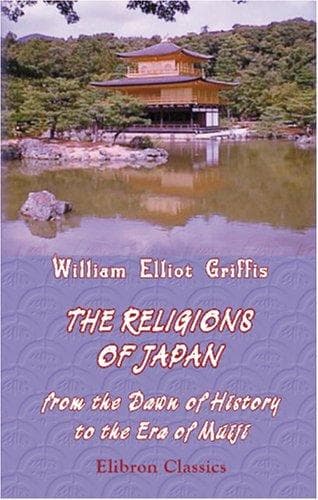
The Religions of Japan, from the Dawn of History to the Era of MéijiGriffis, William Elliot
Religion
The Religions of Japan, from the Dawn of History to the Era of Méiji
Griffis, William Elliot
Japan -- Religion
The Philo and Euhemerus of Japan was the priest Kukai, who was born in
the province of Sanuki, in the year 774. He is better known by his
posthumous title Kōbō Daishi, or the Great Teacher who promulgates
the Law. By this name we shall call him. About his birth, life and
death, have multiplied the usual swaddling bands of Japanese legend and
tradition,[10] and to his tomb at the temple on Mount Kō-ya, the
Campo Santo of Japanese Buddhism, still gather innumerable pilgrims. The
"hall of ten thousand lamps," each flame emblematic of the Wisdom that
saves, is not, indeed, in these days lighted annually as of old; but the
vulgar yet believe that the great master still lives in his mausoleum,
in a state of profoundly silent meditation. Into the hall of bones near
by, covering a deep pit, the teeth and "Adam's apple" of the cremated
bodies of believers are thrown by their relatives, though the pit is
cleared out every three years. The devotees believe that by thus
disposing of the teeth and "Adam's apple," they obtain the same
spiritual privileges as if they were actually entombed there, that is,
of being born again into the heaven of the Bodhisattva or the Pure Land
of Absolute Bliss, by virtue of the mystic formulas repeated by the
great master in his lifetime.
Let us sketch the life of Kōbō,
First named Toto-mono, or Treasure, by his parents, who sent him to
Kiōtō to be educated for the priesthood, the youth spent four
years in the study of the Chinese classics. Dissatisfied with the
teachings of Confucius, he became a disciple of a famous Buddhist
priest, named Iwabuchi (Rock-edge or throne). Soon taking upon himself
the vows of the monk, he was first named Kukai, meaning "space and sea,"
or heaven and earth.[11] He overcame the dragons that assaulted him, by
prayers, by spitting at them the rays of the evening star which had
flown from heaven into his mouth and by repeating the mystic formulas
called Dharani.[12] Annoyed by hobgoblins with whom he was obliged to
converse, he got rid of them by surrounding himself with a consecrated
imaginary enclosure into which they were unable to enter against his
will.
We mention these legends only to call the attention to the fact that
they are but copies of those already accepted in China at that time, and
are the logical and natural fruit of the Tantra school at which we have
glanced. In 804, Kōbō was appointed to visit the Middle Kingdom as
a government student. By means of his clever pen and calligraphic skill
he won his way into the Chinese capital. He became the favored disciple
of a priest who taught him the mystic doctrines of the Yoga. Having
acquired the whole of the system, and equipped himself with a large
library of Buddhist doctrinal works and still more with every sort of
ecclesiastical furniture and religious goods, he returned to Japan.
Public-domain text, read in full here on John Shaqi.
Reviews
Reviews
No reviews yet
Be the first to share your thoughts on this work.
Elsewhere in the archive
Join the Discussion
Join the discussion
Sign in to leave a comment or review.
Sign InorCreate an account