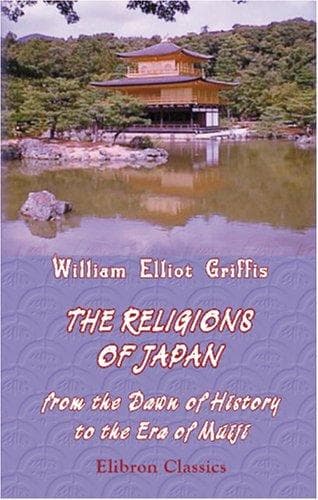
The Religions of Japan, from the Dawn of History to the Era of MéijiGriffis, William Elliot
Religion
The Religions of Japan, from the Dawn of History to the Era of Méiji
Griffis, William Elliot
Japan -- Religion
It was just the time for this brilliant and able ecclesiastic to
succeed. The power and personal influence of the Mikado were weakening,
the court swarmed with monks, the rising military classes were already
safely under the control of the shavelings, and the pen of learning had
everywhere proved itself mightier than the sword and muscle.
Kōbō's particular dialectic weapons were those of the Yoga-chara,
or in Japanese, the Shingon Shu, or Sect of the True Word.[23] He, like
his Chinese master, taught that we can attain the state of the
Enlightened or Buddha, while in the present physical body which was born
of our parents.
This branch of Buddhism is said to have been founded in India about A.D.
200, by a saint who made the discovery of an iron pagoda inhabited by
the holy one, Vagrasattva, who communicated the exact doctrine to those
who have handed it down through the Hindoo and Chinese patriarchs. The
books or scriptures of this sect are in three sutras; yet the essential
point in them is the Mandala or the circle of the Two Parts, or in
Japanese Riyōbu. Introduced into China, A.D. 720, it is known as the
Yoga-chara school.
Kōbō finding a Chinese worm, made a Japanese dragon, able to
swallow a national religion. In the act of deglutition and the long
process of the digestion of Shintō, Japanese Buddhism became
something different from every other form of the faith in Asia. Noted
above all previous developments of Buddhism for its pantheistic
tendencies, the Shingon sect could recognize in any Shintō god,
demi-god, hero, or being, the avatar in a previous stage of existence of
some Buddhist being of corresponding grade.
For example,[24] Amatérasŭ or Ten-Shō-Dai-Jin, the sun-goddess,
becomes Dai Nichi Niōrai or Amida, whose colossal effigies stand in
the bronze images Dai Butsu at Nara, Kiōto and Kamakura. Ojin, the
god of war, became Hachiman Dai Bosatsu, or the great Bodhisattva of the
Eight Banners. Adopted as their patron by the fighting Genji or Minamoto
warriors of mediæval times, the Buddhists could not well afford to have
this popular deity outside their pantheon.
For each of the thirty days of the month, a Bodhisattva, or in Japanese
pronunciation Bosatsu, was appointed. Each of these Bodhisattvas became
a Dai Miō Jin or Great Enlightened Spirit, and was represented as an
avatar in Japan of Buddha in the previous ages, when the Japanese were
not yet prepared to receive the holy law of Buddhism.
Public-domain text, read in full here on John Shaqi.
Reviews
Reviews
No reviews yet
Be the first to share your thoughts on this work.
Elsewhere in the archive
Join the Discussion
Join the discussion
Sign in to leave a comment or review.
Sign InorCreate an account