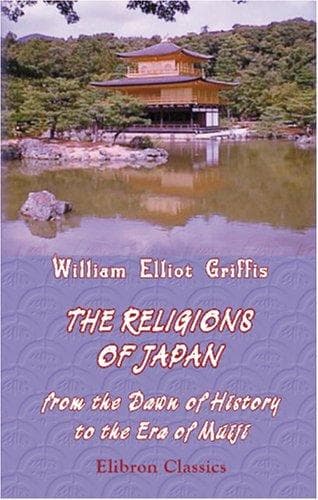
The Religions of Japan, from the Dawn of History to the Era of MéijiGriffis, William Elliot
Religion
The Religions of Japan, from the Dawn of History to the Era of Méiji
Griffis, William Elliot
Japan -- Religion
Where there were not enough Dai Miō Jin already existing in native
traditions to fill out the number required by the new scheme, new titles
were invented. One of these was Ten-jin, Heavenly being or spirit. The
famous statesman and scholar of the tenth century, Sugawara Michizané,
was posthumously named Tenjin, and is even to this day worshipped by
many children of Japan as he was formerly for a thousand years by nearly
all of them, as the divine patron of letters. Kompira, Benten and other
popular deities, often considered as properly belonging to Shintō,
"are evidently the offspring of Buddhist priestly ingenuity."[25] Out of
the eight millions or so of native gods, several hundred were catalogued
under the general term Gon-gen, or temporary manifestations of Buddha.
In this list are to be found not only the heroes of local tradition, but
even deified forces of nature, such as wind and fire. The custom of
making gods of great men after their death, thus begun on a large scale
by Kōbō, has gone on for centuries. Iyéyasŭ, the political
unifier of Japan, shines as a star of the first magnitude in the heavens
of the Riyōbu system, under the mime of Tō-shō-gū, or Great
Light of the East. The common people speak of him as Gon-gen Sama, the
latter word being an honorary form of address for all beings from a baby
to a Bosatsu.
In this way, Kōbō arranged a sort of clearing-house or joint-stock
company in which the Bodhisattvas, kami and other miscellaneous beings,
in either the native or foreign religion, were mutually interchangeable.
In a large sense, this feat of priestly dexterity was but the repetition
in history, of that of Asanga with the Brahmanism and Buddhism of India
three centuries before. It was this Asanga who wrote the Yoga-chara
Bhumi. The succession of syncretists in India, China and Japan is
Asanga, Hiukiō and Kōbō.
The Happy Family of Riyōbu.
Public-domain text, read in full here on John Shaqi.
Reviews
Reviews
No reviews yet
Be the first to share your thoughts on this work.
Elsewhere in the archive
Join the Discussion
Join the discussion
Sign in to leave a comment or review.
Sign InorCreate an account