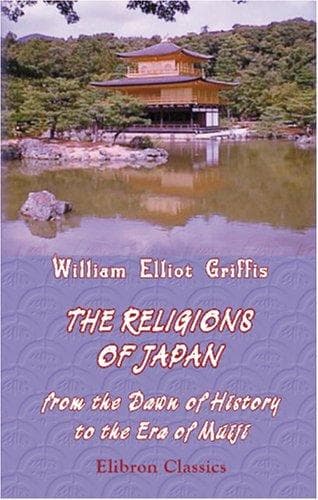
The Religions of Japan, from the Dawn of History to the Era of MéijiGriffis, William Elliot
Religion
The Religions of Japan, from the Dawn of History to the Era of Méiji
Griffis, William Elliot
Japan -- Religion
Nevertheless this attempt at making a happy family and ploughing with an
ox and ass in the same yoke, has not been an unqualified success. It
will sometimes happen that one god escapes the classification made by
the Buddhists and slips into the fold of Shintō, or _vice versa_;
while again the label-makers and pasters--as numerous in scholastic
Buddhism as in sectarian Christendom--have hard work to make the labels
stick. A popular Gon-gen or Dai-Miō-jin, whose name and renown has
for centuries attracted crowds of pilgrims, and yielded fat revenues as
regularly as the autumn harvests, is not readily surrendered by the old
Buddhist proprietors, however cleverly or craftily the bonzes may yield
outward conformity to governmental edicts. On the other hand, the
efforts, both archaeological and practical, which have been made in
recent years by fiercely zealous Shintōists, savor of the smartness
of New Japan more than they suggest either sincerity or edification. It
often requires the finest tact on the part of both the strenuous
Buddhists and the stalwart purists of Shintō, to extricate the
various gods out of the mixture and mess of Riyōbu Shintō, and to
keep them from jostling each other.
This reclaiming and kidnapping of gods and transferring them from one
camp to another, has been especially active since 1870, when, under
government auspices, the Riyōbu temples were purged of all Buddhist
idols, furniture and influences. The term Dai Miō Jin, or Great
Illustrious Spirit, is no longer officially permitted to be used of the
old kami or gods of Shintō, who were known to have existed before the
days of Kōbō. In some cases these gods have lost much of the
esteem in which they were held for centuries. Especially is this true of
the infamous rebel of the tenth century, Masakado.[26] On the entrance
into Yedo of the Imperial army, in 1868, his idol was torn from its
shrine and hacked to pieces by the patriots. His place as a deity (Kanda
Dai Miō Jin, or Great Illustrious Spirit of Kanda) was taken by
another deified being, a brother to the aboriginal earth-god who, in the
ages of the Kami, "resigned his throne in favor of the Mikado's
ancestors when they descended from Heaven." The apotheosis of the rebel
Masakado had been resorted to by the Buddhist canonizers because the
unquiet spirit of the dead man troubled the people. This method of
laying a ghost by making a god of him, was for centuries a favorite one
in Japanese Buddhism. Indeed, a large part of the practical and
parochial duties of the bonzes consists in quieting the restless spirits
of the departed.
All Japanese popular religion of the past has been intensely local and
patriotic. The ancient idea that Nippon was the first country created
and the centre of the world, has persisted through the ages, modifying
every imported religion. Hence the noticeable fact in Japanese Buddhism,
of the comparative degradation of the Hindu deities and the exaltation
of those which were native to the soil.
Public-domain text, read in full here on John Shaqi.
Reviews
Reviews
No reviews yet
Be the first to share your thoughts on this work.
Elsewhere in the archive
Join the Discussion
Join the discussion
Sign in to leave a comment or review.
Sign InorCreate an account