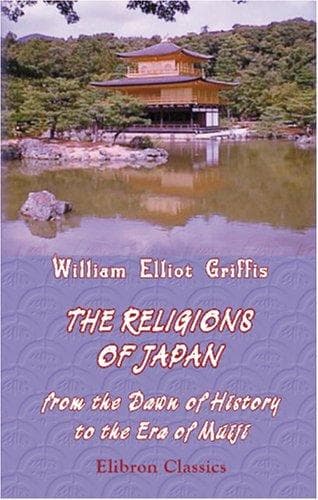
The Religions of Japan, from the Dawn of History to the Era of MéijiGriffis, William Elliot
Religion
The Religions of Japan, from the Dawn of History to the Era of Méiji
Griffis, William Elliot
Japan -- Religion
This process of Shintōizing Buddhism or of Buddhaizing
Shintō--that is, of combining Shintō or purely Japanese ideas and
practices with the systems imported from India, went on for five
centuries. The old native habits and mental characteristics were not
eradicated or profoundly modified; they were rather safely preserved in
so-called Buddhism, not indeed as dead flies in amber but as live
creatures, fattening on a body, which, every year, while keeping outward
form and name, was being emptied of its normal and typical life. It is
no gain to pure water to add either microbes or the food which nourishes
them.
Buddhism Writes New Chapters of Decay.
Phenomenally, the victory was that of Buddhism. The mustard-seed has
indeed become a great tree, lodging every fowl of heaven, clean and
unclean; but potentially and in reality, the leavening power, as now
seen, seems to have been that of Shintō. Or, to change metaphor,
since the hermit crab and the shell were separated by law only one
generation ago, in 1870, we shall soon, before many generations, discern
clearly which has the life and which has only the shell.[34]
There are but few literary monuments[35] of Riyōbuism, and it has
left few or no marks in the native chronicles, misnamed history, which
utterly omit or ignore so many things interesting to the student and
humanist.[36] Yet to this mixture or amalgamation of Buddhism with
Shintō, more probably than to any other direct influence, may also be
ascribed that striking alteration in the system of Chinese ethics or
Confucianism which differentiates the Japanese form from that prevalent
in China. That is, instead of filial piety, the relation of parent and
child, occupying the first place, loyalty, the relation of lord and
retainer, master and servant, became supreme. Although Buddhism made the
Mikado first a King (Tennō) or Son of Heaven (Ten-Shi), and then a
monk (Hō-ō), and after his death a Hotoké or Buddhist deity, it
caused him early to abdicate from actual life. Buddhism is thus directly
responsible for the habitual Japanese resignation from active life
almost as soon as it is entered, by men in all classes. Buddhism started
all along and down through the lines of Japanese society the idea of
early retirement from duty; so that men were considered old at forty,
and _hors concours_ before forty-five.[37] Life was condemned as vanity
of vanities before it was mature, and old age a friend that nobody
wished to meet,[38] although Japanese old age is but European prime. In
a measure, Buddhism is thus responsible for the paralysis of Japanese
civilization, which, like oft-tapped maple-trees, began to die at the
top. This was in accordance with its theories and its literature. In the
Bible there is, possibly, one book which is pessimistic in tone,
Ecclesiastes. In the bulky and dropsical canon of Buddhism there is a
whole library of despondency and despair.
Public-domain text, read in full here on John Shaqi.
Reviews
Reviews
No reviews yet
Be the first to share your thoughts on this work.
Elsewhere in the archive
Join the Discussion
Join the discussion
Sign in to leave a comment or review.
Sign InorCreate an account