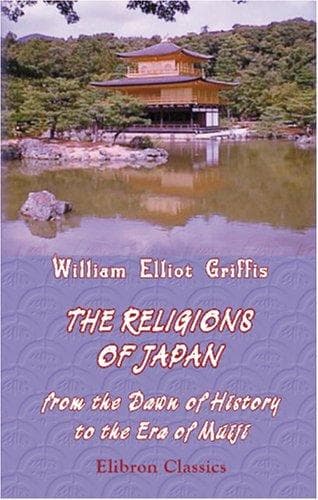
The Religions of Japan, from the Dawn of History to the Era of MéijiGriffis, William Elliot
Religion
The Religions of Japan, from the Dawn of History to the Era of Méiji
Griffis, William Elliot
Japan -- Religion
Nevertheless, the ethical element held its own in the Japanese mind; and
against the pessimism and puerility of Buddhism and the religious
emptiness of Shintō, the bond of Japanese society was sought in the
idea of loyalty. While then, as we repeat, everything that comes to the
Japanese mind suffers as it were "a sea change, into something new and
strange," is it not fair to say that the change made by Kōbō was
at the expense of Buddhism as a system, and that the thing that suffered
reversion was the exotic rather than the native plant? For, in the
emergence of this new idea of loyalty as supreme, Shintō and not
Buddhism was the dictator.
Even more after Kōbō's death than during his life, Japan improved
upon her imported faith, and rapidly developed new sects of all degrees
of reputableness and disreputableness. Had Kōbō lived on through
the centuries, as the boors still believe;[39] he could not have
stopped, had he so desired, the workings of the leaven he had brought
from China. From the sixth to the twelfth century, was the missionary
age of Japanese Buddhism. Then followed two centuries of amazing
development of doctrine. Novelties in religion blossomed, fruited and
became monuments as permanent as the age-enduring forests Hakoné, or
Nikkō. Gautama himself, were he to return to "red earth" again, could
not recognize his own cult in Japan.
In China to-day Buddhism is in a bad state. One writer calls it, "The
emasculated descendant that now occupies the land with its drone of
priests and its temples, in which scarce a worthy disciple of the
learned patriarchs of ancient days is to be found. Received with open
arms, persecuted, patronized, smiled upon, tolerated, it with the last
phase of its existence, has reached, not the halcyon days of peace and
rest, but its final stage, foreshadowing its decay from rottenness and
corruption."[40] So also, in a like report, agree many witnesses. The
common people of China are to-day Taoists rather than Buddhists.[41]
Public-domain text, read in full here on John Shaqi.
Reviews
Reviews
No reviews yet
Be the first to share your thoughts on this work.
Elsewhere in the archive
Join the Discussion
Join the discussion
Sign in to leave a comment or review.
Sign InorCreate an account