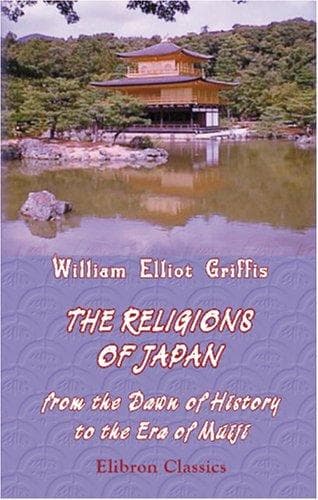
The Religions of Japan, from the Dawn of History to the Era of MéijiGriffis, William Elliot
Religion
The Religions of Japan, from the Dawn of History to the Era of Méiji
Griffis, William Elliot
Japan -- Religion
We repeat it, Riyōbu Buddhism is Japanese Buddhism with vengeance. It
is to-day suffering from the effect of its own sins. Its _ingwa_ is
manifest. Take, for example, the little group of divinities known as the
Seven Gods of Good Fortune, which forms a popular appendage to Japanese
Buddhism and which are a direct and logical growth of the work done by
Kōbō, as shown in his Riyōbu system. Not from foreign writers
and their fancies, nor even from the books which profess to describe
these divinities, do we get such an idea of their real meaning and of
their influence with the people, as we do by observation of every-day
practice, and a study of the idols themselves and of Japanese folk-lore,
popular romance, local history and guidebooks. Those familiar
divinities, indeed, at the present day owe their vitality rather to the
artists than to priests, and, it may be, have received, together with
some rather rude handling, nearly the whole of their extended popularity
and influence from their lay supporters. The Seven Happy Gods of Fortune
form nominally a Buddhist assemblage, and their effigies on the
kami-dana or god-shelf, found in nearly every Japanese house, are
universally visible. The child in Japan is rocked to sleep by the
soothing sound of the lullaby, which is often a prayer to these gods.
Even though it may be with laughing and merriment, that, in their name
the evil gods and imps are exorcised annually on New Year's eve, with
showers of beans which are supposed to be as disagreeable to the
Buddhist demons "as drops of holy water to the Devil," yet few
households are complete without one or more of the images or the
pictures of these favorite deities.
The separate elements of this conglomerate, so typical of Japanese
religion, are from no fewer than four different sources: Brahmanism,
Buddhism, Taoism and Shintōism. "Thus, Bishamon is the Buddhist
_Vâis'ramana_[42] and the Brahmanic Kuvera; Benten is Sarasvatî, the
wife of Brahmâ; Daikoku is an extremely popularised form of Mahakala,
the black-faced Temple Guardian; Hotéi has Taoist attributes, but is
regarded as an incarnation of Màitreyâ, the Buddhist Messiah;
Fuku-roku-jiu is of purely Taoist origin, and is perhaps a
personification of Lao-Tsze himself; Ju-ró-jin is almost certainly a
duplicate of Fuku-roku-jiu; and, lastly, Ebisu, as the son of Izanagi
and Izanami, is a contribution from the Shintō hero-worship."[43] If
Riyōbu Buddhism be two-fold, here is a texture or amalgam that is
_shi-bu_, four-fold. Let us watch lest _go-bu_, with Christianity mixed
in, be the next result of the process. To play the Japanese game of
go-ban, with Christianity as the fifth counter, and Jesus as a
Palestinian avatar of some Dhyani Buddha, crafty priests in Japan are
even now planning.
Public-domain text, read in full here on John Shaqi.
Reviews
Reviews
No reviews yet
Be the first to share your thoughts on this work.
Elsewhere in the archive
Join the Discussion
Join the discussion
Sign in to leave a comment or review.
Sign InorCreate an account