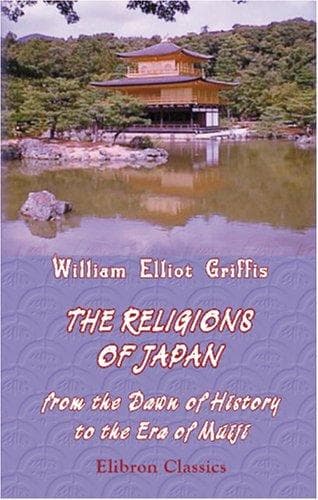
The Religions of Japan, from the Dawn of History to the Era of MéijiGriffis, William Elliot
Religion
The Religions of Japan, from the Dawn of History to the Era of Méiji
Griffis, William Elliot
Japan -- Religion
When in 1869, to Rutgers College, came an application through Rev. Dr.
Guido F. Verbeck, of Tōkiō, from Fukui for a young man to organize
schools upon the American principle in the province of Echizen
(ultra-Buddhistic, yet already so liberally leavened by the ethical
teachings of Yokoi Héishiro), the Faculty made choice of the author.
Accepting the honor and privilege of being one of the "beginners of a
better time," I caught sight of peerless Fuji and set foot on Japanese
soil December 29, 1870. Amid a cannonade of new sensations and fresh
surprises, my first walk was taken in company with the American
missionary (once a marine in Perry's squadron, who later invented the
jin-riki-sha), to see a hill-temple and to study the wayside shrines
around Yokohama. Seven weeks' stay in the city of Yedo--then rising out
of the débris of feudalism to become the Imperial capital, Tōkiō,
enabled me to see some things now so utterly vanished, that by some
persons their previous existence is questioned. One of the most
interesting characters I met personally was Fukuzawa, the reformer, and
now "the intellectual father of half of the young men of ... Japan." On
the day of the battle of Uyéno, July 11, 1868, this far-seeing patriot
and inquiring spirit deliberately decided to keep out of the strife, and
with four companions of like mind, began the study of Wayland's Moral
Science. Thus were laid the foundations of his great school, now a
university.
Journeying through the interior, I saw many interesting phenomena of
popular religions which are no longer visible. At Fukui in Echizen, one
of the strongholds of Buddhism, I lived nearly a year, engaged in
educational work, having many opportunities of learning both the
scholastic and the popular forms of Shintō and of Buddhism. I was
surrounded by monasteries, temples, shrines, and a landscape richly
embroidered with myth and legend. During my four years' residence and
travel in the Empire, I perceived that in all things the people of Japan
were _too_ religious.
Public-domain text, read in full here on John Shaqi.
Reviews
Reviews
No reviews yet
Be the first to share your thoughts on this work.
Join the Discussion
Join the discussion
Sign in to leave a comment or review.
Sign InorCreate an account