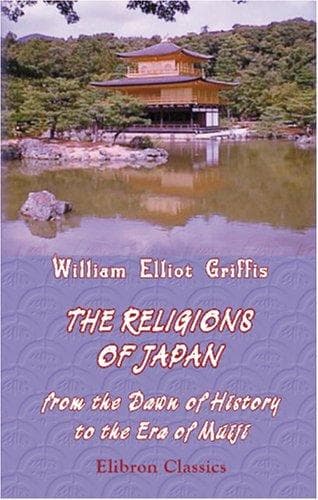
The Religions of Japan, from the Dawn of History to the Era of MéijiGriffis, William Elliot
Religion
The Religions of Japan, from the Dawn of History to the Era of Méiji
Griffis, William Elliot
Japan -- Religion
[Footnote 9: See The Art of Landscape Gardening in Japan, T.A.S.J., Vol.
XIV.; Theory of Japanese Flower Arrangements, by J. Conder, T.A.S.J.,
Vol. XVII.; T.J., p. 168; M.E., p. 437; T.J., p. 163.]
[Footnote 10: _The_ book, by excellence, on the Japanese house, is
Japanese Homes and Their Surroundings, by E.S. Morse. See also
Constructive Art in Japan, T.A.S.J., Vol. II., p. 57, III., p. 20;
Feudal Mansions of Yedo, Vol. VII., p. 157.]
[Footnote 11: See Hearn's Glimpses of Unfamiliar Japan, pp. 385, 410,
and _passim_.]
[Footnote 12: For pathetic pictures of Japanese daily life, see Our
Neighborhood, by the late Dr. T.A. Purcell, Yokohama, 1874; A Japanese
Boy, by Himself (S. Shigémi), New Haven, 1889; Lafcadio Hearn's Glimpses
of Unfamiliar Japan, Boston, 1894.]
[Footnote 13: Klaproth's Annales, and S. and H. _passim_.]
[Footnote 14: See Pfoundes's Fuso Mimi Bukuro, p. 130, for a list of
grades from Ho-ō or cloistered emperor, Miya or sons of emperors,
chief priests of sects, etc., down to priests in charge of inferior
temples. This Budget of Notes, pp. 99-144, contains much valuable
information, and was one of the first publications in English which shed
light upon the peculiarities of Japanese Buddhism.]
[Footnote 15: Isaiah xl. 19, 20, and xli. 6, 7, read to the dweller in
Japan like the notes of a reporter taken yesterday.]
[Footnote 16: T.J., p. 339; Notes on Some Minor Japanese Religious
Practices, _Journal of the Anthropological Institute_, May, 1893;
Lowell's Esoteric Shintō, T.A.S.J., Vol. XXI.; Satow's The Shintō
Temples of Isé, T.A.S.J., Vol. II., p. 113.]
[Footnote 17: M.E., p. 45; American Cyclopaedia, Japan,
Literature--History, Travels, Diaries, etc.]
[Footnote 18: That is, no dialects like those which separate the people
of China. The ordinary folks of Satsuma and Suruga, for example,
however, would find it difficult to understand each other if only the
local speech were used. Men from the extremes of the Empire use the
Tōkiō standard language in communicating with each other.]
[Footnote 19: For some names of Buddhist temples in Shimoda see Perry's
Narrative, pp. 470-474, described by Dr. S. Wells Williams; S. and H.
_passim_.]
[Footnote 20: The Abbé Huc in his Travels in Tartary was one of the
first to note this fact. I have not noticed in my reading that the
Jesuit missionaries in Japan in the seventeenth century call attention
to the matter. See also the writings of Arthur Lillie, voluminous but
unconvincing, Buddha and Early Buddhism, and Buddhism and Christianity,
London, 1893.]
[Footnote 21: M.E., p. 252.]
[Footnote 22: T.J., p. 70.]
[Footnote 23: See The Higher Buddhism in the Light of the Nicene Creed,
Tōkiō, 1894, by Rev. A. Lloyd.]
Public-domain text, read in full here on John Shaqi.
Reviews
Reviews
No reviews yet
Be the first to share your thoughts on this work.
Elsewhere in the archive
Join the Discussion
Join the discussion
Sign in to leave a comment or review.
Sign InorCreate an account