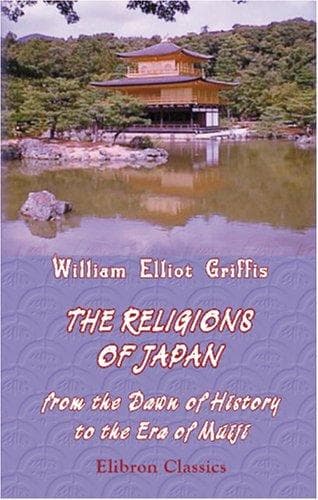
The Religions of Japan, from the Dawn of History to the Era of MéijiGriffis, William Elliot
Religion
The Religions of Japan, from the Dawn of History to the Era of Méiji
Griffis, William Elliot
Japan -- Religion
[Footnote 24: "I preach with ever the same voice, taking enlightenment
as my text. For this is equal for all; no partiality is in it, neither
hatred nor affection.... I am inexorable, bear no love or hatred towards
anyone, and proclaim the law to all creatures without distinction, to
the one as well as to the other."--Saddharma Pundarika.]
[Footnote 25: Unbeaten Tracks in Japan, Vol. II., p. 247.]
[Footnote 26: For the symbolism of the lotus see M.E., p. 437; Unbeaten
Tracks in Japan, Vol. I., p. 299; M.E. index; and Saddharma Pundarika,
Kern's translation, p. 76, note:
"Here the Buddha is represented as a wise and benevolent father; he is
the heavenly father, Brahma. As such ho was represented as sitting on a
'lotus-seat.' How common this representation was in India, at least in
the sixth century of our era, appears from Varâhamihira's
Brihat-Sainhita, Ch. 58, 44, where the following rule is laid down for
the Buddha idols: 'Buddha shall be (represented) sitting on a
lotus-seat, like the father of the world.'"]
[Footnote 27: See The Northern Buddhist Mythology in _Journal of the
Royal Asiatic Society_, January, 1894.]
[Footnote 28: See The Pictorial Arts of Japan, and Descriptive and
Historical Catalogue, William Anderson, pp. 13-94.]
[Footnote 29: See fylfot in Century Dictionary.]
[Footnote 30: The word _vagra_, diamond, is a constituent in scores of
names of sutras, especially those whose contents are metaphysical in
their nature. The Vajrasan, Diamond Throne or Thunderbolt seat, was the
name applied to the most sacred part of the great temple reared by Asoka
on the site of the bodhi tree, under which Gautama received
enlightenment. "The adamantine truths of Buddha struck like a
thunderbolt upon the superstitious of his age." "The word vagra has the
two senses of hardness and utility. In the former sense it is understood
to be compared to the secret truth which is always in existence and not
to be broken. In the latter sense it implies the power of the
enlightened, that destroys the obstacles of passions."--B.N., p. 88. "As
held in the arms of Kwannon and other images in the temples," the vagra
or "diamond club" (is that) with which the foes of the Buddhist Church
are to be crushed.--S. and H., p. 444. Each of the gateway gods Ni-ō
(two Kings, Indra and Brahma) "bears in his hand the tokko (Sanskrit
_vagra_), an ornament originally designed to represent a diamond club,
and now used by priests and exorcists, as a religious sceptre
symbolizing the irresistible power of prayer, meditation, and
incantation."--Chamberlain's Hand-book for Japan, p. 31.]
Public-domain text, read in full here on John Shaqi.
Reviews
Reviews
No reviews yet
Be the first to share your thoughts on this work.
Elsewhere in the archive
Join the Discussion
Join the discussion
Sign in to leave a comment or review.
Sign InorCreate an account