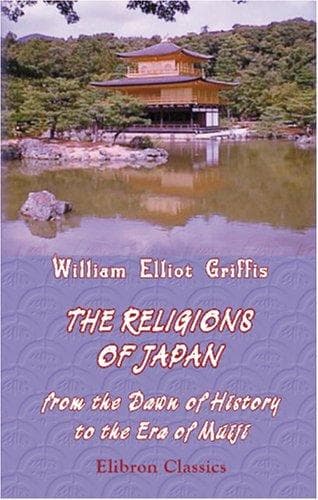
The Religions of Japan, from the Dawn of History to the Era of MéijiGriffis, William Elliot
Religion
The Religions of Japan, from the Dawn of History to the Era of Méiji
Griffis, William Elliot
Japan -- Religion
[Footnote 5: The "Firando" of the old books. See Cock's Diary. It is
difficult at first to recognize the Japanese originals of some of the
names which figure in the writings of Charlevoix, Léon Pagés, and the
European missionaries, owing to their use of local pronunciation, and
their spelling, which seems peculiar. One of the brilliant
identifications of Mr. Ernest Satow, now H.B.M. Minister at Tangier, is
that of Kuroda in the "Kondera"' of the Jesuits.]
[Footnote 6: See Mr. E.M. Matow's Vicissitudes of the Church at
Yamaguchi. T.A.S.J., Vol. VII., pp. 131-156.]
[Footnote 7: Nobunaga was Nai Dai Jin, Inner (Junior) Prime Minister,
one in the triple premiership, peculiar to Korea and Old Japan, but was
never Shōgun, as some foreign writers have supposed.]
[Footnote 8: See The Jesuit Mission Press in Japan, by E. Satow,
1591-1610 (privately printed, London, 1888). Review of the same by B.H.
Chamberlain, T.A.S.J., Vol. XVII., p. 91.]
[Footnote 9: Histoire de l'Église, Vol. I, p. 490; Rein, p. 277.
Takayama is spoken of in the Jesuit Records as Jûsto Ucondono. A curious
book entitled Justo Ucondono, Prince of Japan, in which the writer, who
is "less attentive to points of style than to matters of faith," labors
to show that "the Bible alone" is "found wanting," and only the
"Teaching Church" is worthy of trust, was published in Baltimore, in
1854.]
[Footnote 10: How Hidéyoshi made use of the Shin sect of Buddhists to
betray the Satsuma clansmen is graphically told in Mr. J.H. Gubbin's
paper, Hidéyoshi and the Satsuma Clan, T.A.S.J., Vol. VIII, pp. 124-128,
143.]
[Footnote 11: Corea the Hermit Nation, Chaps. XII.-XXI., pp. 121-123;
Mr. W.G. Aston's Hidéyoshi's Invasion of Korea, T.A.S.J., Vol. VI., p.
227; IX, pp. 87, 213; XI., p. 117; Rev. G.H. Jones's The Japanese
Invasion, The Korean Repository, Seoul, 1892.]
[Footnote 12: Brave Little Holland and What She Taught Us, Boston, 1893,
p. 247.]
[Footnote 13: See picture and description of this temple--"fairly
typical of Japanese Buddhist architecture," Chamberlain's Handbook for
Japan, p. 26; G.A. Cobbold's, Religion in Japan, London, 1894, p. 72.]
[Footnote 14: T.A.S.J., see Vol. VI., pp. 46, 51, for the text of the
edicts.]
[Footnote 15: M.E., p. 262, Chamberlain's Handbook for Japan, p. 59.]
[Footnote 16: The Origin of Spanish and Portuguese Rivalry in Japan, by
E.M. Satow, T.A.S.J., Vol. XVIII., p. 133.]
[Footnote 17: See Chapter VIII., W.G. Dixon's Gleanings from Japan.]
[Footnote 18: T.A.S.J., Vol. VI., pp. 48-50.]
Public-domain text, read in full here on John Shaqi.
Reviews
Reviews
No reviews yet
Be the first to share your thoughts on this work.
Elsewhere in the archive
Join the Discussion
Join the discussion
Sign in to leave a comment or review.
Sign InorCreate an account