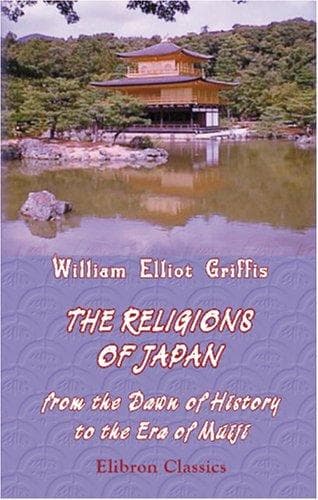
The Religions of Japan, from the Dawn of History to the Era of MéijiGriffis, William Elliot
Religion
The Religions of Japan, from the Dawn of History to the Era of Méiji
Griffis, William Elliot
Japan -- Religion
[Footnote 19: In the inscription upon the great bell, at the temple
containing the image of Dai Butsŭ or Great Buddha, reared by Hidéyori
and his mother, one sentence contained the phrase _Kokka anko, ka_ and
_ko_ being Chinese for _Iyé_ and _yasŭ_, which the Yedo ruler
professed to believe mockery. In another sentence, "On the East it
welcomes the bright moon, and on the West bids farewell to the setting
sun," Iyéyasŭ discovered treason. He considered himself the rising
sun, and Hidéyori the setting moon.--Chamberlain's Hand-book for Japan,
p. 300.]
[Footnote 20: I have found the Astor Library in New York especially rich
in works of this sort.]
[Footnote 21: Nitobé's United States and Japan, p. 13, note.]
[Footnote 22: This insurrection has received literary treatment at the
hands of the Japanese in Shimabara, translated in The Far East for 1872;
Woolley's Historical Notes on Nagasaki, T.A.S.J., Vol. IX., p. 125;
Koeckebakker and the Arima Rebellion, by Dr. A.J.C. Geerts, T.A.S.J.,
Vol. XI., 51; Inscriptions on Shimabara and Amakusa, by Henry Stout,
T.A.S.J., Vol. VII, p. 185.]
[Footnote 23: "Persecution extirpated Christianity from Japan."--History
of Rationalism, Vol. II, p. 15.]
[Footnote 24: T.A.S.J., Vol. VI., Part I., p. 62; M.E. pp. 531, 573.]
[Footnote 25: Political, despite the attempt of many earnest members of
the order to check this tendency to intermeddle in politics; see Dr.
Murray's Japan, p. 245, note, 246.]
[Footnote 26: See abundant illustration in Léon Pagés' Histoire de la
Religion Chrétienne en Japon, a book which the author read while in
Japan amid the scenes described.]
[Footnote 27: _The Japan Evangelist_, Vol. I., No. 2, p. 96.]
CHAPTER XII
TWO CENTURIES OF SILENCE
[Footnote 1: See Diary of Richard Cocks, and Introduction by R.M.
Thompson, Hakluyt Publications, 1883.]
[Footnote 2: For the extent of Japanese influence abroad, see M.E., p.
246; Rein, Nitobe, and Hildreth; Modern Japanese Adventurers, T.A.S.J.,
Vol. VII., p. 191; The Intercourse between Japan and Siam in the
Seventeenth Century, by E.M. Satow, T.A.S.J., Vol. XIII., p. 139; Voyage
of the Dutch Ship Grol, T.A.S.J., Vol. XI., p. 180.]
[Footnote 3: The United States and Japan, p. 16.]
[Footnote 4: See Professor J.H. Wigmore's elaborate work, Materials for
the Study of Private Law in Old Japan, T.A.S.J., Tōkiō, 1892.]
[Footnote 5: See the Legacy of Iyéyasŭ, by John Frederic Lowder,
Yokohama, 1874, with criticisms and discussions by E.M. Satow and others
in the _Japan Mail_; Dixon's Japan, Chapter VII.; Professor W.E.
Grigsby, in T.A.S.J., Vol. III., Part II., p. 131, gives another
version, with analysis, notes, and comments; Rein's Japan, pp. 314,
315.]
[Footnote 6: Old Japan in the days of its inclusiveness was a secret
society on a vast scale, with every variety and degree of selfishness,
mystery, secrecy, close-corporationism, and tomfoolery. See article
Esotericism in T.J., p. 143.]
Public-domain text, read in full here on John Shaqi.
Reviews
Reviews
No reviews yet
Be the first to share your thoughts on this work.
Elsewhere in the archive
Join the Discussion
Join the discussion
Sign in to leave a comment or review.
Sign InorCreate an account