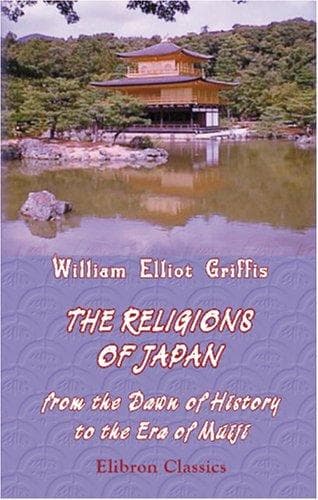
The Religions of Japan, from the Dawn of History to the Era of Méiji — John Shaqi
The Religions of Japan, from the Dawn of History to the Era of MéijiGriffis, William Elliot
Religion
The Religions of Japan, from the Dawn of History to the Era of Méiji
Griffis, William Elliot
Japan -- Religion
In a critical study, either of the general body of national tradition or
of the ancient documents, we must continually be on our guard against
the usual assumption that Chinese civilization came in earlier than it
really did. This assumption colors all modern Japanese popular ideas,
art and literature. The vice of the pupil nations surrounding the Middle
Kingdom is their desire to have it believed that Chinese letters and
culture among them is an nearly coeval with those of China as can be
made truly or falsely to appear. The Koreans, for example, would have us
believe that their civilization, based on letters and introduced by
Kishi, is "four thousand years old" and contemporaneous with China's
own, and that "the Koreans are among the oldest people of the world."[5]
The average modern Japanese wishes the date of authentic or official
history projected as far back as possible. Yet he is a modest man
compared with his mediæval ancestor, who constructed chronology out of
ink-stones. Over a thousand years ago a deliberate forgery was
officially put on paper. A whole line of emperors who never lived was
canonized, and clever penmen set down in ink long chapters which
describe what never happened.[6] Furthermore, even after, and only eight
years after the fairly honest "Kojiki" had been compiled, the book
called "Nihongi," or Chronicles of Japan, was written. All the internal
and not a little external evidence shows that the object of this book is
to give the impression that Chinese ideas, culture and learning had long
been domesticated in Japan. The "Nihongi" gives dates of events supposed
to have happened fifteen hundred years before, with an accuracy which
may be called villainous; while the "Kojiki" states that Wani, a Korean
teacher, brought the "Thousand Character Classic" to Japan in A.D. 285,
though that famous Chinese book was not composed until the sixth
century, or A.D. 550.[7]
Even to this day it is nearly impossible for an American to get a Korean
"frog in the well"[8] to understand why the genuine native life and
history, language and learning of his own peninsular country is of
greater value to the student than the pedantry borrowed from China. Why
these possess any interest to a "scholar" is a mystery to the head in
the horsehair net. Anything of value, he thinks, _must_ be on the
Chinese model. What is not Chinese is foolish and fit for women and
children only. Furthermore, Korea "always had" Chinese learning. This is
the sum of the arguments of the Korean literati, even as it used to be
of the old-time hatless Yedo scholar of shaven skull and topknot.
Public-domain text, read in full here on John Shaqi.
Reviews
Reviews
No reviews yet
Be the first to share your thoughts on this work.
Join the Discussion
Join the discussion
Sign in to leave a comment or review.
Sign InorCreate an account