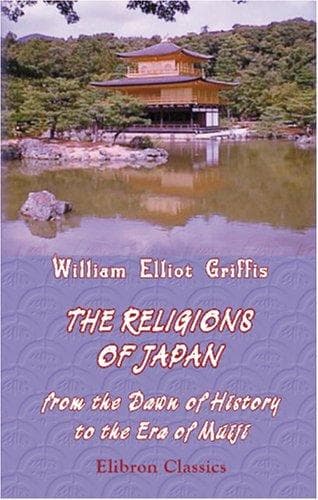
The Religions of Japan, from the Dawn of History to the Era of Méiji — John Shaqi
The Religions of Japan, from the Dawn of History to the Era of MéijiGriffis, William Elliot
Religion
The Religions of Japan, from the Dawn of History to the Era of Méiji
Griffis, William Elliot
Japan -- Religion
The sun was first, and then came the wonder, admiration and worship of
men. The personification and pedigree of the sun were late figments. To
connect their ancestors with the sun-goddess and the heavenly gods, was
a still later enterprise of the "Mikado reverencers" of this earlier
time. Both the god-way in its early forms and Shintō in its later
development, were to them political as well as ecclesiastical institutes
of dogma. Both the religion which they themselves brought and cultivated
and the aboriginal religion which the Yamato men found, were used as
engines in the making of Mikadoism, which is the heart of Shintō.
Not until two centuries after the coming of Buddhism and of Asiatic
civilization did it occur to the Japanese to reduce to writing the
floating legends and various cycles of tradition which had grown up
luxuriantly in different parts of "the empire," or to express in the
Chinese character the prayers and thanksgivings which had been handed
down orally through many generations. These norito had already assumed
elegant literary form, rich in poetic merit, long before Chinese writing
was known. They, far more than the less certain philosophy of the
"Kojiki," are of undoubted native origin. It is nearly certain that the
prehistoric Japanese did not borrow the literary forms of the god-way
from China, as any one familiar with the short, evenly balanced and
antithetical sentences of Chinese style can see at once. The norito are
expressions, in the rhythmical and rhetorical form of worship, of the
articles of faith set forth in the historic summary which we have given.
We propose to illustrate the dogmas by quoting from the rituals in Mr.
Satow's masterly translation. The following was addressed to the
sun-goddess (Amatérasŭ no Mikami, or the
From-Heaven-Shining-Great-Deity) by the priest-envoy of the priestly
Nakatomi family sent annually to the temples at Isé, the Mecca of
Shintō. The _sevran_ referred to in the ritual is the Mikado. This
word and all the others printed in capitals are so rendered in order to
express in English the force of "an untranslatable honorific syllable,
supposed to be originally identical with a root meaning 'true,' but no
longer possessing that signification." Instead of the word "earth," that
of "country" (Japan) is used as the correlative of Heaven.
Ritual in Praise of the Sun-goddess.
He (the priest-envoy) says: Hear all of you, ministers of the
gods and sanctifiers of offerings, the great ritual, the
heavenly ritual, declared in the great presence of the
From-Heaven-Shining-Great-DEITY, whose praises are fulfilled by
setting up the stout pillars of the great HOUSE, and exalting
the cross-beams to the plain of high heaven at the sources of
the Isuzu River at Uji in Watarai.
Public-domain text, read in full here on John Shaqi.
Reviews
Reviews
No reviews yet
Be the first to share your thoughts on this work.
Join the Discussion
Join the discussion
Sign in to leave a comment or review.
Sign InorCreate an account