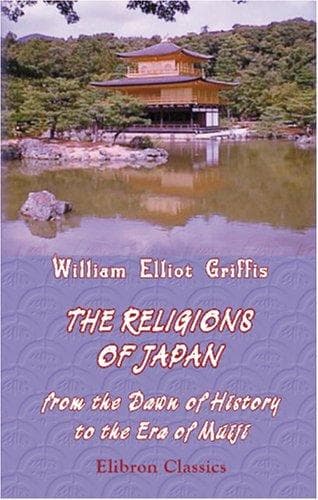
The Religions of Japan, from the Dawn of History to the Era of MéijiGriffis, William Elliot
Religion
The Religions of Japan, from the Dawn of History to the Era of Méiji
Griffis, William Elliot
Japan -- Religion
Fire is, in a sense, the foundation and first necessity of civilization,
and it is interesting to study the myths as to the origin of fire, and
possibly even more interesting to compare the Greek and Japanese
stories. As we know, old-time popular etymology makes Prometheus the
fore-thinker and brother of Epimetheus the after-thinker. He is the
stealer of the fire from heaven, in order to make men share the secret
of the gods. Comparative philology tells us, however, that the Sanskrit
_Pramantha_ is a stick that produces fire. The "Kojiki" does indeed
contain what is probably the later form of the fire-myth about two
brothers, Prince Fire-Shine and Fire-Fade, which suggests both the later
Greek myth of the fore- and after-thinker and a tradition of a flood.
The first, and most probably older, myth in giving the origin of fire
does it in true Japanese style, with details of parturition. After
numerous other deities had been born of Izanagi and Izanami, it is said
"that they gave birth to the Fire-Burning-Swift-Male-Deity, another name
for whom is the Deity-Fire-Shining-Prince, and another name is the
Deity-Fire-Shining-Elder." In the other ancient literature this fire-god
is called Ho-musubi, the Fire-Producer.
Izanami yielded up her life upon the birth of her son, the fire-god; or,
as the sacred text declares, she "divinely retired"[14] into Hades. From
her corpse sprang up the pairs of gods of clay, of metal, and other kami
that possessed the potency of calming or subduing fire, for clay resists
and water extinguishes. Between the mythical and the liturgical forms of
the original narrative there is considerable variation.
The Norito entitled the "Quieting of Fire" gives the ritual form of the
myth. It contains, like so many Norito, less the form of prayer to the
Fire-Producer than a promise of offerings. Not so much by petitions as
by the inducements of gifts did the ancient worshippers hope to save the
palace of the Mikado from the fire-god's wrath. We omit from the text
those details which are offensive to modern and western taste.
I declare with the great ritual, the heavenly ritual, which was
bestowed on him at the time when, by the WORD of the Sovran's
dear progenitor and progenitrix, who divinely remain in the
plain of high heaven, they bestowed on him the region under
heaven, saying:
"Let the Sovran GRANDCHILD'S augustness tranquilly rule over the
country of fresh spikes which flourishes in the midst of the
reed-moor as a peaceful region."
When ... Izanami ... had deigned to bear the many hundred
myriads of gods, she also deigned to bear her dear youngest
child of all, the Fire-producer god, ... and said:
Public-domain text, read in full here on John Shaqi.
Reviews
Reviews
No reviews yet
Be the first to share your thoughts on this work.
Join the Discussion
Join the discussion
Sign in to leave a comment or review.
Sign InorCreate an account