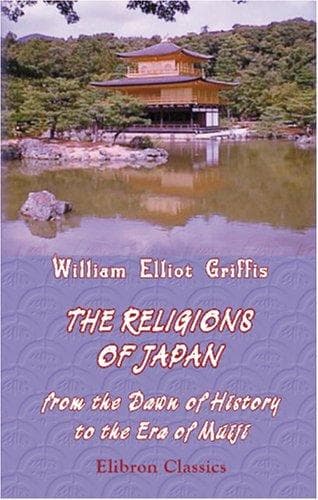
The Religions of Japan, from the Dawn of History to the Era of Méiji — John Shaqi
The Religions of Japan, from the Dawn of History to the Era of MéijiGriffis, William Elliot
Religion
The Religions of Japan, from the Dawn of History to the Era of Méiji
Griffis, William Elliot
Japan -- Religion
It would task the keenest and ablest Shintōist to deduce or construct
a system of theology, or of ethics, or of anthropology from the mass of
tradition so full of gaps and discord as that found in the Kojiki, and
none has done it. Nor do the inaccurate, distorted, and often almost
wholly factitious translations, so-called, of French and other writers,
who make versions which hit the taste of their occidental readers far
better than they express the truth, yield the desired information. Like
the end strands of a new spider's web, the lines of information on most
vital points are still "in the air."
The Ethics of the God-way.
There are no codes of morals inculcated in the god-way, for even its
modern revivalists and exponents consider that morals are the invention
of wicked people like the Chinese; while the ancient Japanese were pure
in thought and act. They revered the gods and obeyed the Mikado, and
that was the chief end of man, in those ancient times when Japan was the
world and Heaven was just above the earth. Not exactly on Paul's
principle of "where there is no law there is no transgression," but
utterly scouting the idea that formulated ethics were necessary for
these pure-minded people, the modern revivalists of Shintō teach that
all that is "of faith" now is to revere the gods, keep the heart pure,
and follow its dictates.[17] The naïveté of the representatives of
Shintō at Chicago in A.D. 1893, was almost as great as that of the
revivalists who wrote when Japan was a hermit nation.
The very fact that there was no moral commandments, not even of loyalty
or obedience such as Confucianism afterward promulgated and formulated,
is proof to the modern Shintōist that the primeval Japanese were pure
and holy; they did right, naturally, and hence he does not hesitate to
call Japan, the Land of the Gods, the Country of the Holy Spirits, the
Region Between Heaven and Earth, the Island of the Congealed Drop, the
Sun's Nest, the Princess Country, the Land of Great Peace, the Land of
Great Gentleness, the Mikado's Empire, the Country ruled by a Theocratic
Dynasty. He considers that only with the vice brought over from the
Continent of Asia were ethics both imported and made necessary.[18]
Public-domain text, read in full here on John Shaqi.
Reviews
Reviews
No reviews yet
Be the first to share your thoughts on this work.
Join the Discussion
Join the discussion
Sign in to leave a comment or review.
Sign InorCreate an account