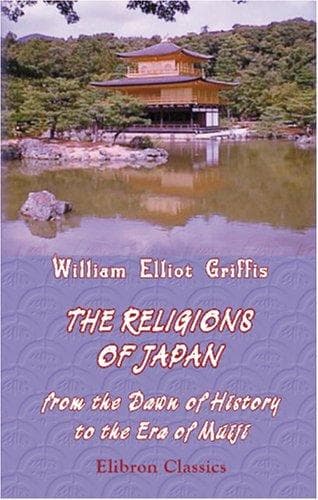
The Religions of Japan, from the Dawn of History to the Era of MéijiGriffis, William Elliot
Religion
The Religions of Japan, from the Dawn of History to the Era of Méiji
Griffis, William Elliot
Japan -- Religion
Whether, however, men can exactly reproduce and think for themselves the
thoughts of others who have been dead for a millennium, is an open
question. The new system is apt to be transparent. Just as it is nearly
impossible for us to restore the religious life, thoughts and orthodoxy
of the men who lived before the flood, so in the writings of the
revivalists of pure Shintō we detect the thoughts of Dutchmen, of
Chinese, and of very modern Japanese. Unconsciously, those who would
breathe into the dry bones of dead Shintō the breath of the
nineteenth century, find themselves compelled to use an oxygen and
nitrogen generator made in Holland and mounted with Chinese apparatus;
withal, lacquered and decorated with the art of to-day. To change from
metaphor to matter of fact, modern "pure Shintō" is mainly a mass of
speculation and philosophy, with a tendency of which the ancient god-way
knew nothing.
The Modern Revivalists of Kami no Michi.
Passing by further mention of the fifteen or more corrupt sects of
Shintōists, we name with honor the native scholars of the
seventeenth century, who followed the illustrious example of Iyéyasŭ,
the political unifier of Japan. They ransacked the country and purchased
from temples, mansions and farmhouses, old manuscripts and books, and
forming libraries began anew the study of ancient language and history.
Kéichu (1640-1701), a Buddhist priest, explored and illumined the poems
of the Manyōshu. Kada Adzumarō, born in 1669 near Kiōto, the
son of a shrine-keeper at Inari, attempted the mastery of the whole
archaic native language and literature. He made a grand beginning. He is
unquestionably the founder of the school of Pure Shintō. He died in
1736. His successor and pupil was Mabuchi (1697-1769), who claimed
direct descent from that god which in the form of a colossal crow had
guided the first chief of the Yamato tribe as he led his invaders
through the country to found the line of Mikados. After Mabuchi came
Motoöri (1730-1801) a remarkable scholar and critic, who, with erudition
and acuteness, analyzed the ancient literature and showed what were
Chinese or imported elements and what was of native origin. He
summarized the principles of the ancient religion, reasserted and
illuminated with amazing learning and voluminous commentary the archaic
documents, expounded and defended the ancient cosmogony, and in the
usual style of Japanese polemics preached anew the doctrines of
Shintō. With wonderful naïveté and enthusiasm, Motoöri taught that
Japan was the first part of the earth created, and that it is therefore
The Land of the Gods, the Country of the Holy Spirits. The stars were
created from the muck which fell from the spear of Izanagi as he thrust
it into the warm earth, while the other countries were formed by the
spontaneous consolidation of the foam of the sea. Morals were invented
by the Chinese because they were an immoral people, but in Japan there
Public-domain text, read in full here on John Shaqi.
Reviews
Reviews
No reviews yet
Be the first to share your thoughts on this work.
Join the Discussion
Join the discussion
Sign in to leave a comment or review.
Sign InorCreate an account