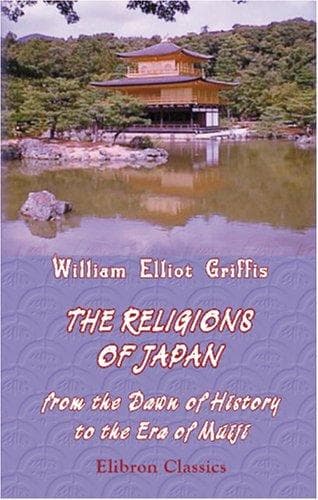
The Religions of Japan, from the Dawn of History to the Era of MéijiGriffis, William Elliot
Religion
The Religions of Japan, from the Dawn of History to the Era of Méiji
Griffis, William Elliot
Japan -- Religion
is no necessity for any system of morals, as every Japanese acts aright
if he only consults his own heart. The duty of a good Japanese consists
in obeying the Mikado, without questioning whether his commands are
right or wrong. The Mikado is god and vicar of all the gods, hence
government and religion are the same, the Mikado being the centre of
Church and State, which are one. Did the foreign nations know their duty
they would at once hasten to pay tribute to the Son of Heaven in
Kiōto.
It is needless here to dwell upon the tremendous power of Shintō as a
political system, especially when wedded with the forces, generated in
the minds of the educated Japanese by modern Confucianism. The Chinese
ethical system, expanded into a philosophy as fascinating as the English
materialistic school of to-day, entered Japan contemporaneously with the
revival of the Way of the Gods and of native learning. In full rampancy
of their vigor, in the seventeenth century these two systems began that
generation of national energy, which in the eighteenth century was
consolidated and which in the nineteenth century, though unknown and
unsuspected by Europeans or Americans, was all ready for phenomenal
manifestation and tremendous eruption, even while Perry's fleet was
bearing the olive branch to Japan. As we all know, this consolidation of
forces from the inside, on meeting, not with collision but with union,
the exterior forces of western civilization, formed a resultant in the
energies which have made New Japan.
The Great Purification of 1870.
Public-domain text, read in full here on John Shaqi.
Reviews
Reviews
No reviews yet
Be the first to share your thoughts on this work.
Join the Discussion
Join the discussion
Sign in to leave a comment or review.
Sign InorCreate an account