The Religious Experience of the Roman People: From the Earliest Times to the Age of Augustus — John Shaqi
The Religious Experience of the Roman People: From the Earliest Times to the Age of AugustusFowler, W. Warde (William Warde)
Religion
The Religious Experience of the Roman People: From the Earliest Times to the Age of Augustus
Fowler, W. Warde (William Warde)
Cults -- Rome; Rome -- Religion
Produced by Turgut Dincer, Ted Garvin and the Online
Distributed Proofreading Team at https://www.pgdp.net
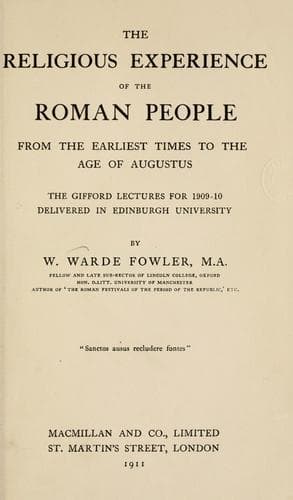
THE
RELIGIOUS EXPERIENCE
OF THE
ROMAN PEOPLE
FROM THE EARLIEST TIMES TO THE
AGE OF AUGUSTUS
THE GIFFORD LECTURES FOR 1909-10
DELIVERED IN EDINBURGH UNIVERSITY
BY
W. WARDE FOWLER, M.A.
FELLOW AND LATE SUB-RECTOR OF LINCOLN COLLEGE, OXFORD
HON. D.LITT. UNIVERSITY OF MANCHESTER
AUTHOR OF 'THE ROMAN FESTIVALS OF THE PERIOD OF THE REPUBLIC,' ETC.
"Sanctos ausus recludere fontes"
MACMILLAN AND CO., LIMITED
ST. MARTIN'S STREET, LONDON
1911
TO
PROFESSOR W.R. HARDIE
AND
MY MANY OTHER KIND FRIENDS AND FRIENDLY HEARERS
IN EDINBURGH
PREFACE
Lord Gifford in founding his lectureship directed that the lectures
should be public and popular, _i.e._ not restricted to members of a
University. Accordingly in lecturing I endeavoured to make myself
intelligible to a general audience by avoiding much technical discussion
and controversial matter, and by keeping to the plan of describing in
outline the development and decay of the religion of the Roman
City-state. And on the whole I have thought it better to keep to this
principle in publishing the lectures; they are printed for the most part
much as they were delivered, and without footnotes, but at the end of
each lecture students of the subject will find the notes referred to by
the numbers in the text, containing such further information or
discussion as has seemed desirable. My model in this method has been the
admirable lectures of Prof. Cumont on "les Religions Orientales dans le
Paganisme Romain."
I wish to make two remarks about the subject-matter of the lectures.
First, the idea running through them is that the primitive religious (or
magico-religious) instinct, which was the germ of the religion of the
historical Romans, was gradually atrophied by over-elaboration of
ritual, but showed itself again in strange forms from the period of the
Punic wars onwards. For this religious instinct I have used the Latin
word _religio_, as I have explained in the _Transactions of the Third
International Congress for the History of Religions_, vol. ii. p. 169
foll. I am, however, well aware that some scholars take a different view
of the original meaning of this famous word, which has been much
discussed since I formed my plan of lecturing. But I do not think that
those who differ from me on this point will find that my general
argument is seriously affected one way or another by my use of the word.
Public-domain text, read in full here on John Shaqi.
Reviews
Reviews
No reviews yet
Be the first to share your thoughts on this work.
Join the Discussion
Join the discussion
Sign in to leave a comment or review.
Sign InorCreate an account