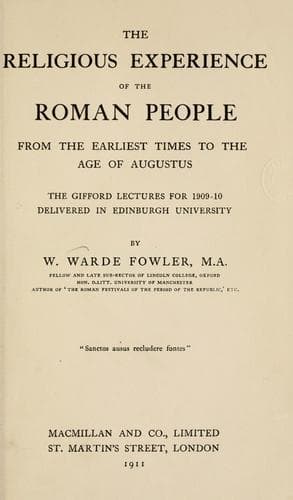
The Religious Experience of the Roman People: From the Earliest Times to the Age of AugustusFowler, W. Warde (William Warde)
Religion
The Religious Experience of the Roman People: From the Earliest Times to the Age of Augustus
Fowler, W. Warde (William Warde)
Cults -- Rome; Rome -- Religion
It must be remarked, too, that as a consequence of this
unattractiveness, the accounts given in standard works of the general
features of this religion are rather chilling and repellent. More than
fifty years ago, in the first book of his _Roman History_, Mommsen so
treated of it--not indeed without some reservation,--and in this matter,
as in so many others, his view remained for many years the dominant one.
He looked at this religion, as was natural to him, from the point of
view of law; in religion as such he had no particular interest. If I am
not mistaken, it was for him, except in so far as it is connected with
Roman law, the least interesting part of all his far-reaching Roman
studies. More recent writers of credit and ability have followed his
lead, and stress has been laid on the legal side of religion at Rome; it
has been described over and over again as merely a system of contracts
between gods and worshippers, secured by hard and literal formalism, and
without ethical value or any native principle of growth. Quite recently,
for example, so great an authority as Professor Cumont has written of it
thus:--
"Il n'a peut etre jamais existe aucune religion aussi froide, aussi
prosaique que celle des Romains. Subordonnee a la politique, elle
cherche avant tout, par la stricte execution de pratiques appropriees, a
assurer a l'Etat la protection des dieux ou a detourner les effets de
leur malveillance. Elle a conclu avec les puissances celestes un contrat
synallagmatique d'ou decoulent des obligations reciproques: sacrifices
d'une part, faveurs de l'autre.... Sa liturgie rappelle par la minutie
de ses prescriptions l'ancien droit civil. Cette religion se defie des
abandons de l'ame et des elans de la devotion." And he finishes his
description by quoting a few words of the late M. Jean Reville: "The
legalism of the Pharisees, in spite of the dryness of their ritualistic
minutiae, could make the heart vibrate more than the formalism of the
Romans."[2]
Public-domain text, read in full here on John Shaqi.
Reviews
Reviews
No reviews yet
Be the first to share your thoughts on this work.
Join the Discussion
Join the discussion
Sign in to leave a comment or review.
Sign InorCreate an account