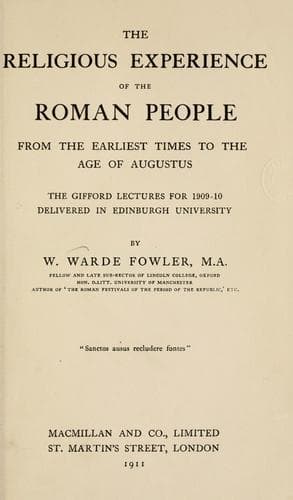
The Religious Experience of the Roman People: From the Earliest Times to the Age of AugustusFowler, W. Warde (William Warde)
Religion
The Religious Experience of the Roman People: From the Earliest Times to the Age of Augustus
Fowler, W. Warde (William Warde)
Cults -- Rome; Rome -- Religion
At this point I wish to notice one or two results of the adoption of a
religious calendar such as I have been describing, which are more to the
purpose of these lectures than some of the details I have had to point
out. First, let us remember that agricultural operations necessarily
vary in date according to the season, and that most of the rural
festivals of ancient Italy were not fixed to a particular day, but were
_feriae conceptivae_, settled perhaps according to the decision of some
meeting of heads of families or officers of a pagus. That this was so we
may conjecture from the fact that those which survived into historical
times, _e.g._ Compitalia and Paganalia, and were celebrated in the city,
though not as _sacra pro populo_,[204] were of varying date. But all the
festivals of the calendar were necessarily fixed, and the days on which
they were held were made over to the gods. Now by being thus fixed they
would soon begin to get out of relation to agricultural life; just as,
if the harvest festivals of our churches were fixed to one day
throughout the country, the meaning of the religious service would
sooner or later begin to lose something of its force. And how much the
more would this be so if the calendar itself, from ignorance or
mismanagement, began to get out of relation with the true season, as in
course of time was frequently the case? When once under such
circumstances the meaning of a religious rite is lost, where is its
psychological efficacy? In the life of the old Latin farmer, as we saw,
his religion was a reality, an organic growth, coincident at every point
with the perils he encountered in his daily toil; here, in the
City-state, it must from the beginning have had a tendency to become an
unreality, and it ended by becoming one entirely. Some of the old rites
may have attached new meanings to themselves; it is possible, for
example, that beneath the military rites of March there was an original
agricultural significance; the Saturnalia became a merry mid-winter
festival for a town population. But a great number wholly lost meaning,
and were so forgotten or neglected in course of time that even learned
men like Varro do not seem to have been able to explain them. The only
practical question about them for the later Romans was whether their
days were _dies fasti_ or _nefasti_ or _comitiales_,--what work might or
might not be done on them.
Public-domain text, read in full here on John Shaqi.
Reviews
Reviews
No reviews yet
Be the first to share your thoughts on this work.
Elsewhere in the archive
Join the Discussion
Join the discussion
Sign in to leave a comment or review.
Sign InorCreate an account